Medicine reading guide
Ezetimibe
Cholesterol absorption inhibitor
Adults using single-ingredient ezetimibe tablets for primary hyperlipidemia, including heterozygous familial hypercholesterolemia. Other indications, children and fixed-combination products are outside this guide.
Educational information. Independent clinical review pending. This is a selective explanation, not the full prescribing information.
Uses / Symptoms
- High LDL cholesterol.
Effects
- Lowers LDL cholesterol.
Side effects
- Diarrhea; joint or limb pain.
- Serious: muscle injury, liver problems, allergy.
Selected information; not a complete safety list. Full prescribing information and patient guidance ↗
How it works
Ezetimibe reduces how much cholesterol enters your body from the intestine. Your liver then takes more LDL cholesterol out of the blood, helping lower the LDL result on your blood test.
Perspective answer sources
Section-two answers source-checked October 17, 2026; independent clinical review pending.
Read the mechanism, step by step
Less enters: ezetimibe inhibits NPC1L1 at the intestinal surface, reducing cholesterol uptake.
More is cleared: less cholesterol reaches the liver; liver cholesterol stores fall and LDL receptors increase, helping remove cholesterol from blood.
Common questions
What is it for?
With diet, it lowers LDL in primary hyperlipidemia, usually alongside a statin; alone when additional LDL-lowering therapy is not possible.
How does it work?
It reduces cholesterol absorption in the small intestine.
Is ezetimibe a statin?
No. It targets the NPC1L1 cholesterol transporter in the intestine.
How do I know it is helping?
Your clinician checks LDL blood tests to assess response.
Does it need food?
It can be taken with or without food. Follow your prescription.
Do diet and exercise still matter?
Continue the diet and exercise plan agreed with your clinician.
What side effects might I notice?
Diarrhea, nasal symptoms, and joint, back or limb pain may occur. Report persistent or severe symptoms.
When should I get help?
Get emergency help for breathing difficulty or facial/throat swelling. Contact your doctor immediately for unexplained muscle pain or weakness, or yellow skin or eyes.
Which medicines need checking?
Cyclosporine, fibrates and bile acid sequestrants need checking. Some combinations require monitoring or separated administration; ask your pharmacist.
What if I have liver problems?
Tell your clinician about liver disease. Ezetimibe is not recommended with moderate or severe liver impairment.
What about pregnancy or breastfeeding?
Discuss pregnancy, pregnancy plans or breastfeeding with your prescriber. Call if you become pregnant during treatment.
Can I stop when I feel well?
Do not stop just because you feel well. Discuss changes with your prescriber.
Animation chapters, evidence & visual limits
Adults using single-ingredient ezetimibe tablets for primary hyperlipidemia, including heterozygous familial hypercholesterolemia. Other indications, children and fixed-combination products are outside this story.
Educational, source-checked storyboard; independent scientific review is pending. NPC1L1 is a functional schematic, not a pore model. Uptake microsteps remain simplified; no dose, atomic pose, guaranteed LDL change or plaque-removal claim is supplied.
Original conceptual illustrations. AI-assisted editorial source check; independent clinical review pending. No recorded narration.
Chapter 1: Cholesterol arrives from two sources
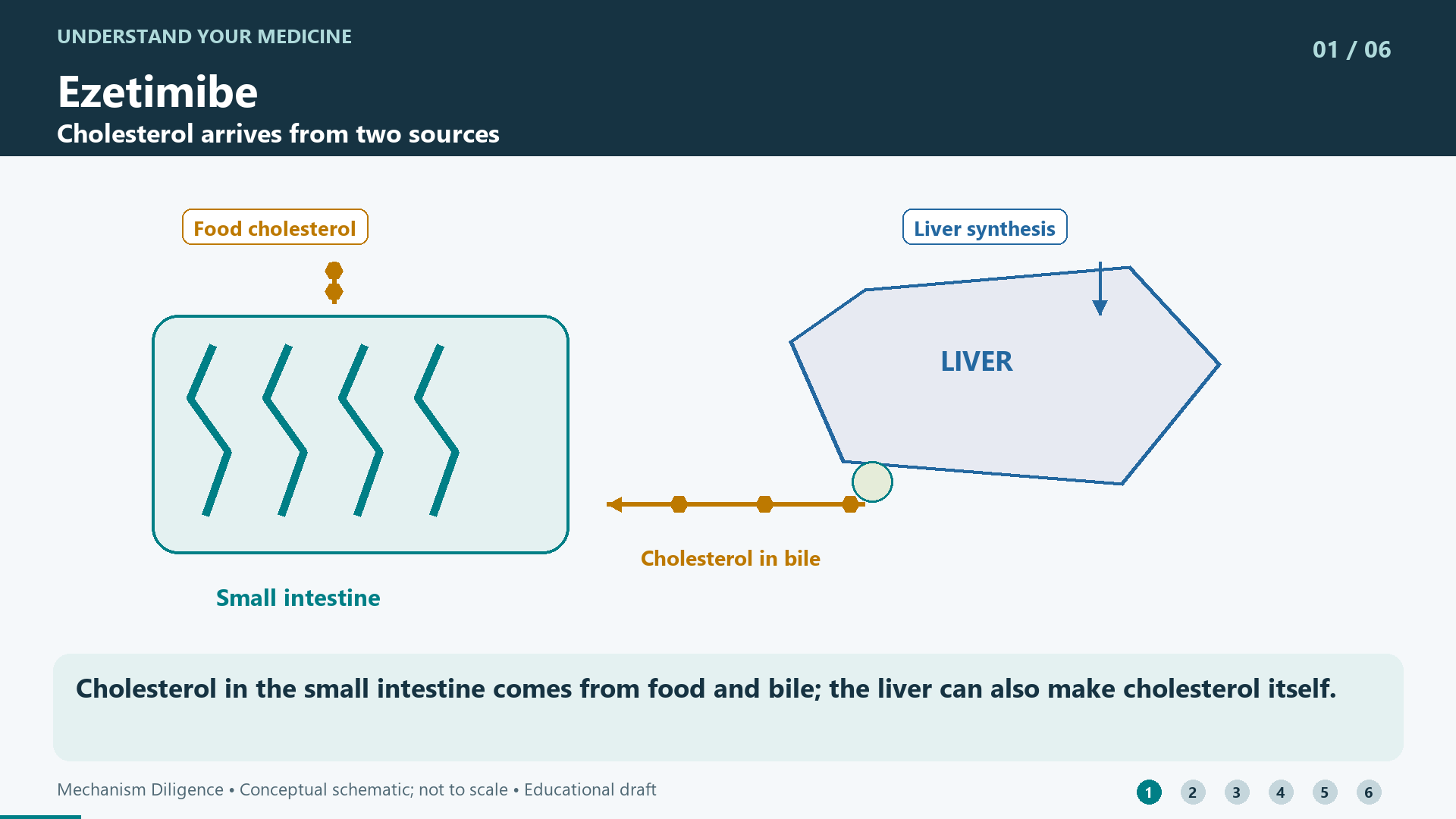
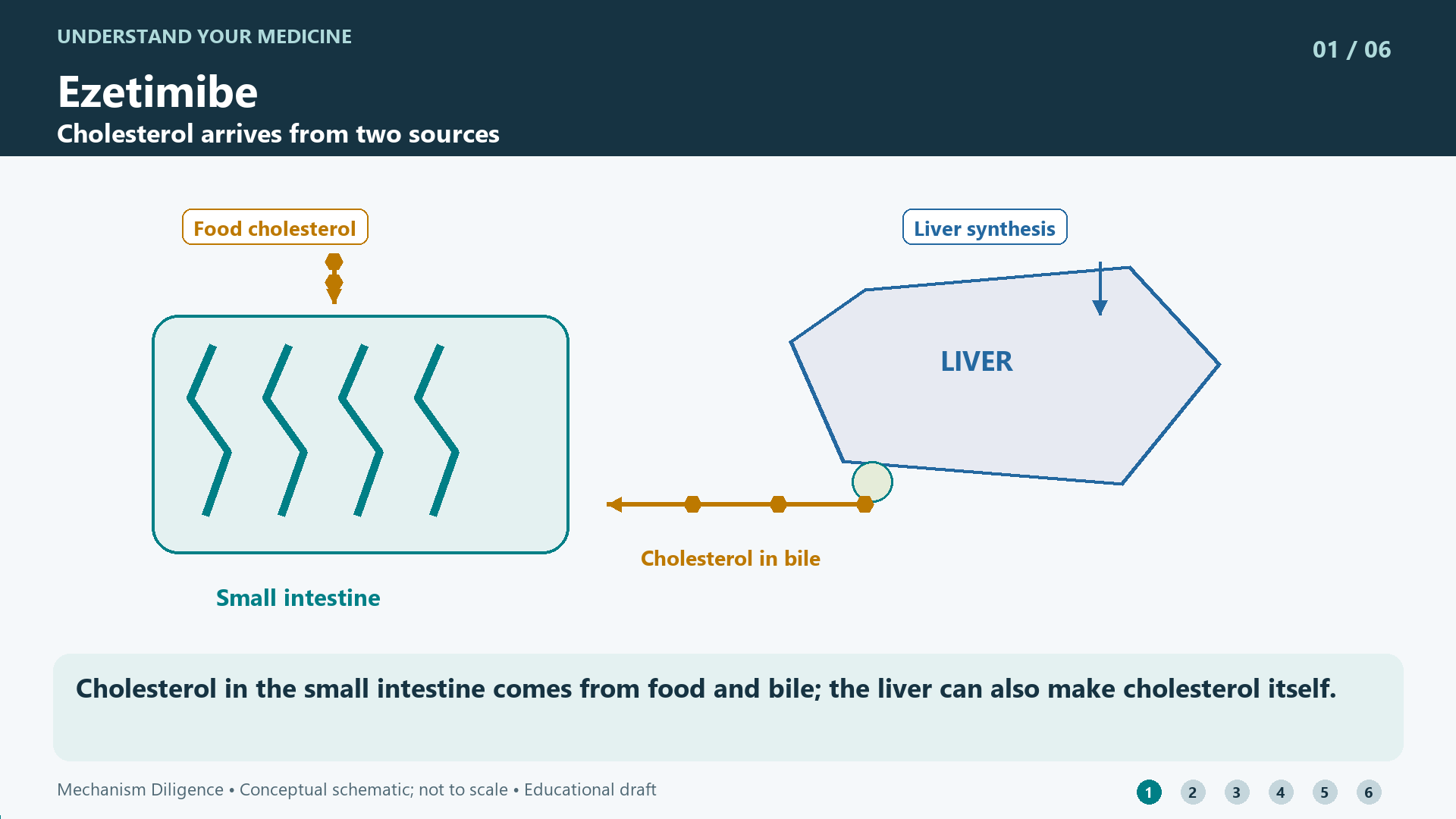
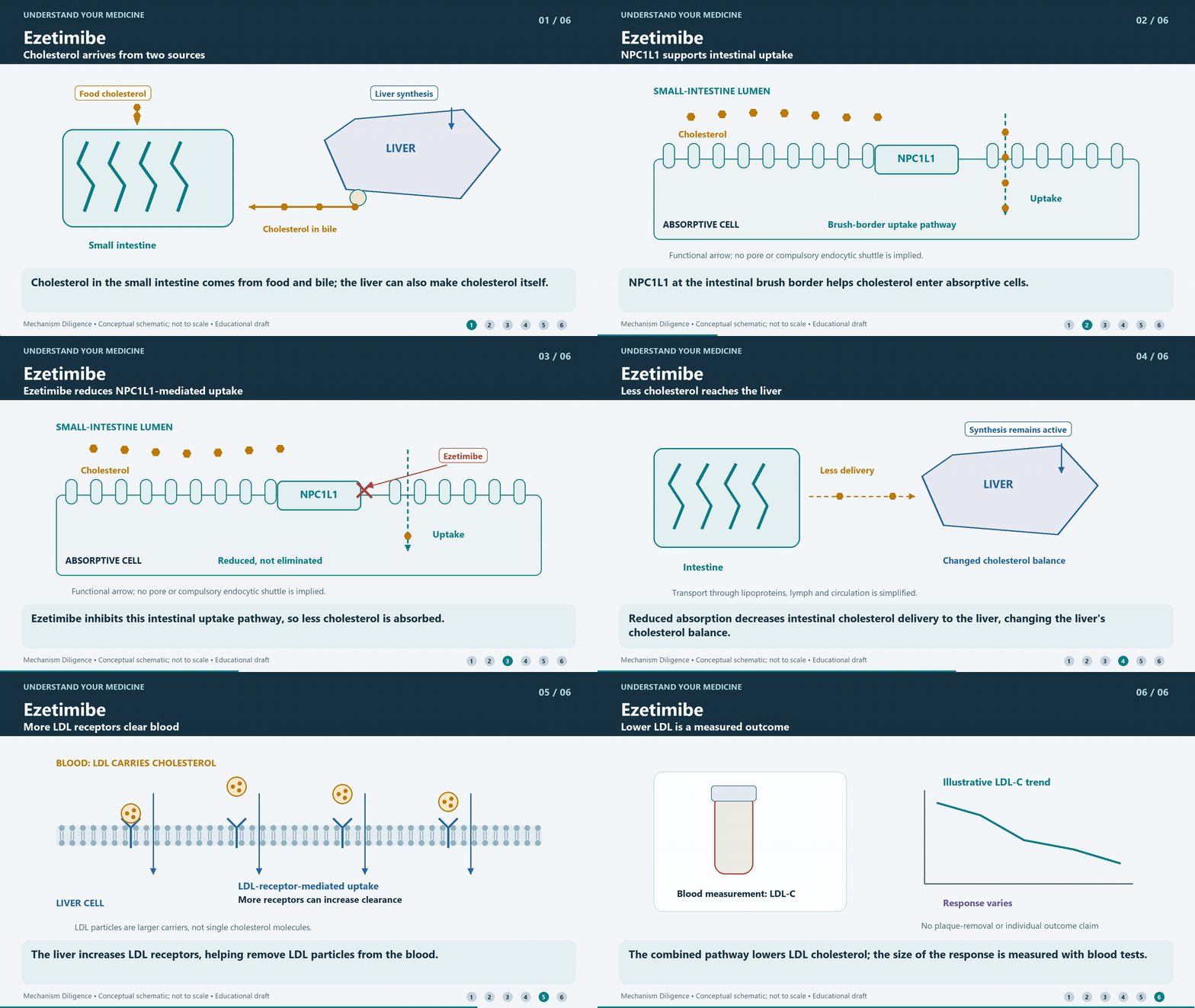
Cholesterol in the small intestine comes from food and bile; the liver can also make cholesterol itself.
The intestinal pool includes recycled biliary cholesterol as well as dietary cholesterol. A separate synthesis input prevents the misleading impression that all blood cholesterol comes directly from meals.
Relative amounts vary and are not represented by particle numbers; digestion and micellar chemistry are simplified.
- Ezetimibe tablet label: cholesterol-source physiology · Section 12.1 only: dietary and biliary intestinal cholesterol and hepatic synthesis · Older U.S. label used only for physiology; not used for current indications, contraindications or outcome claims · checked 2026-10-17
Chapter 2: NPC1L1 supports intestinal uptake
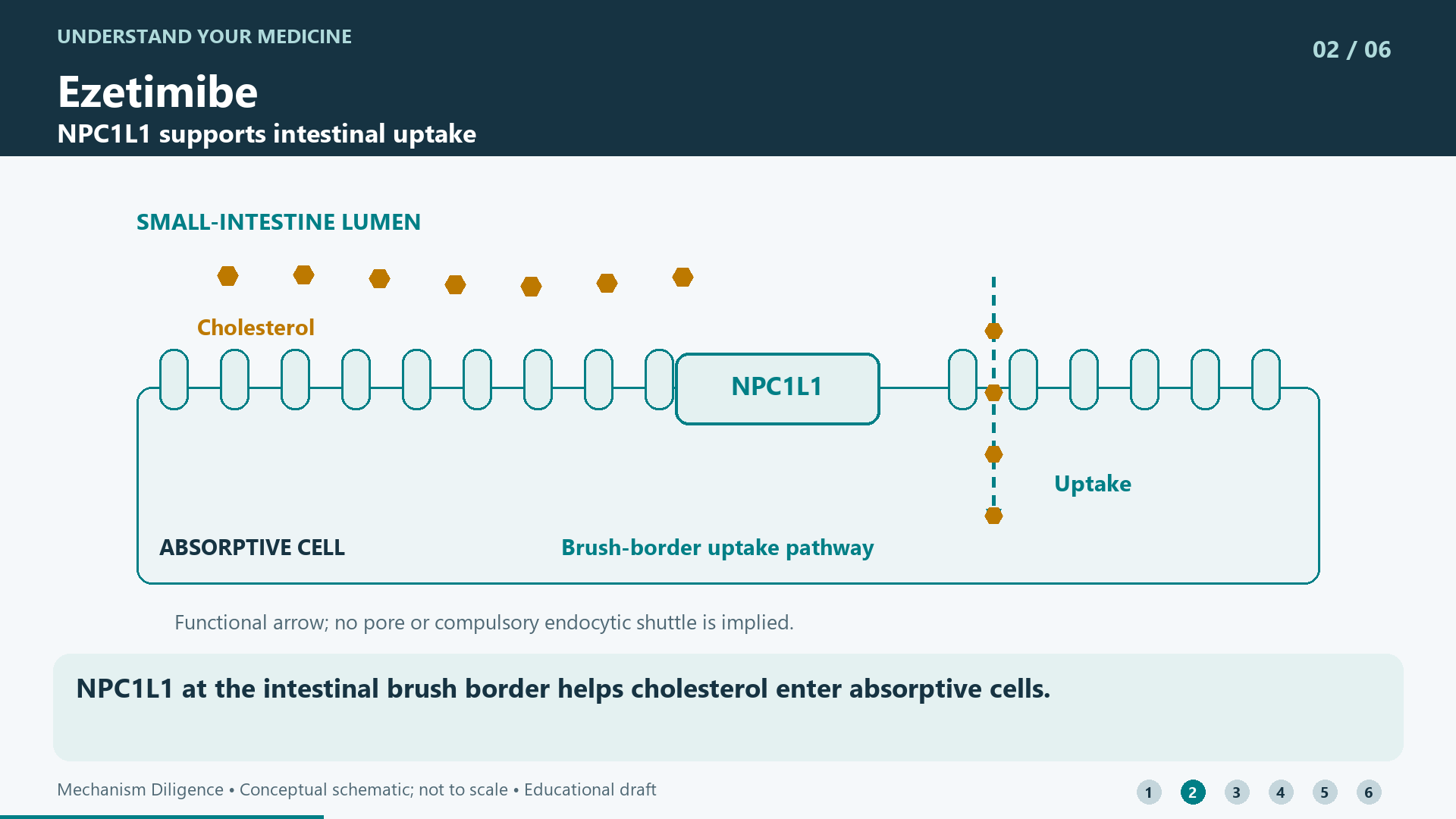
NPC1L1 at the intestinal brush border helps cholesterol enter absorptive cells.
Localization and knockout experiments established an important NPC1L1-dependent absorption pathway. The functional step is well supported even though different experiments describe different microscopic transport events.
Mouse genetic evidence establishes pathway involvement, not a human molecular movie; cultured-cell results differ on the necessity of endocytosis.
- Altmann et al. Niemann-Pick C1 Like 1 protein is critical for intestinal cholesterol absorption (2004) · Abstract: intestinal brush-border localization and knockout-mouse response; DOI 10.1126/science.1093131 · Primary localization and mouse genetic study; indexed abstract checked · checked 2026-10-17
- Ge et al. Ezetimibe blocks sterol-induced internalization of NPC1L1 (2008) · Abstract: proposed clathrin/AP2-dependent uptake model; DOI 10.1016/j.cmet.2008.04.001 · Primary cell-mechanism study; indexed abstract checked · checked 2026-10-17
- Ezetimibe-sensitive cholesterol uptake by NPC1L1 protein does not require endocytosis (2016) · Abstract: RH7777 rat hepatoma-cell uptake and internalization experiments · Primary cell-mechanism study; indexed abstract/excerpts checked; full page challenge blocked direct reading · checked 2026-10-17
Chapter 3: Ezetimibe reduces NPC1L1-mediated uptake
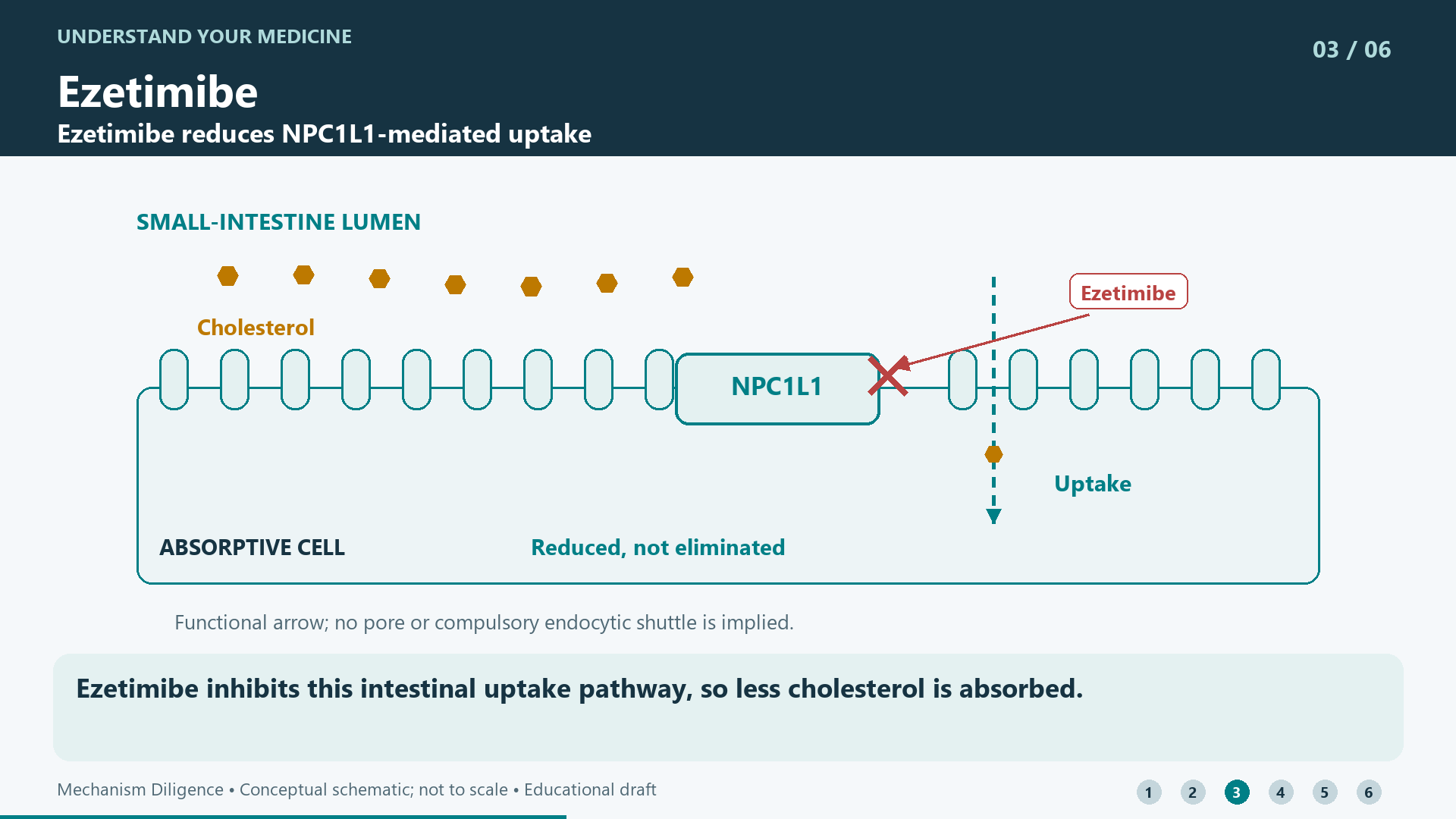
Ezetimibe inhibits this intestinal uptake pathway, so less cholesterol is absorbed.
The labeled target is NPC1L1. Ezetimibe also forms an active glucuronide metabolite. The animation depicts the net drug effect without selecting an unsettled endocytosis-only explanation.
The functional inhibition is established; the illustration does not resolve the precise uptake cycle or imply complete blockade.
- Zetia prescribing information, Organon · Sections 1, 5.2-5.3, 12.1-12.3, 14; label updated November 25, 2025; prescribing information revised February 2024 · U.S. prescribing information; live selected sections checked · checked 2026-10-17
- Ge et al. Ezetimibe blocks sterol-induced internalization of NPC1L1 (2008) · Abstract: proposed clathrin/AP2-dependent uptake model; DOI 10.1016/j.cmet.2008.04.001 · Primary cell-mechanism study; indexed abstract checked · checked 2026-10-17
- Ezetimibe-sensitive cholesterol uptake by NPC1L1 protein does not require endocytosis (2016) · Abstract: RH7777 rat hepatoma-cell uptake and internalization experiments · Primary cell-mechanism study; indexed abstract/excerpts checked; full page challenge blocked direct reading · checked 2026-10-17
Chapter 4: Less cholesterol reaches the liver
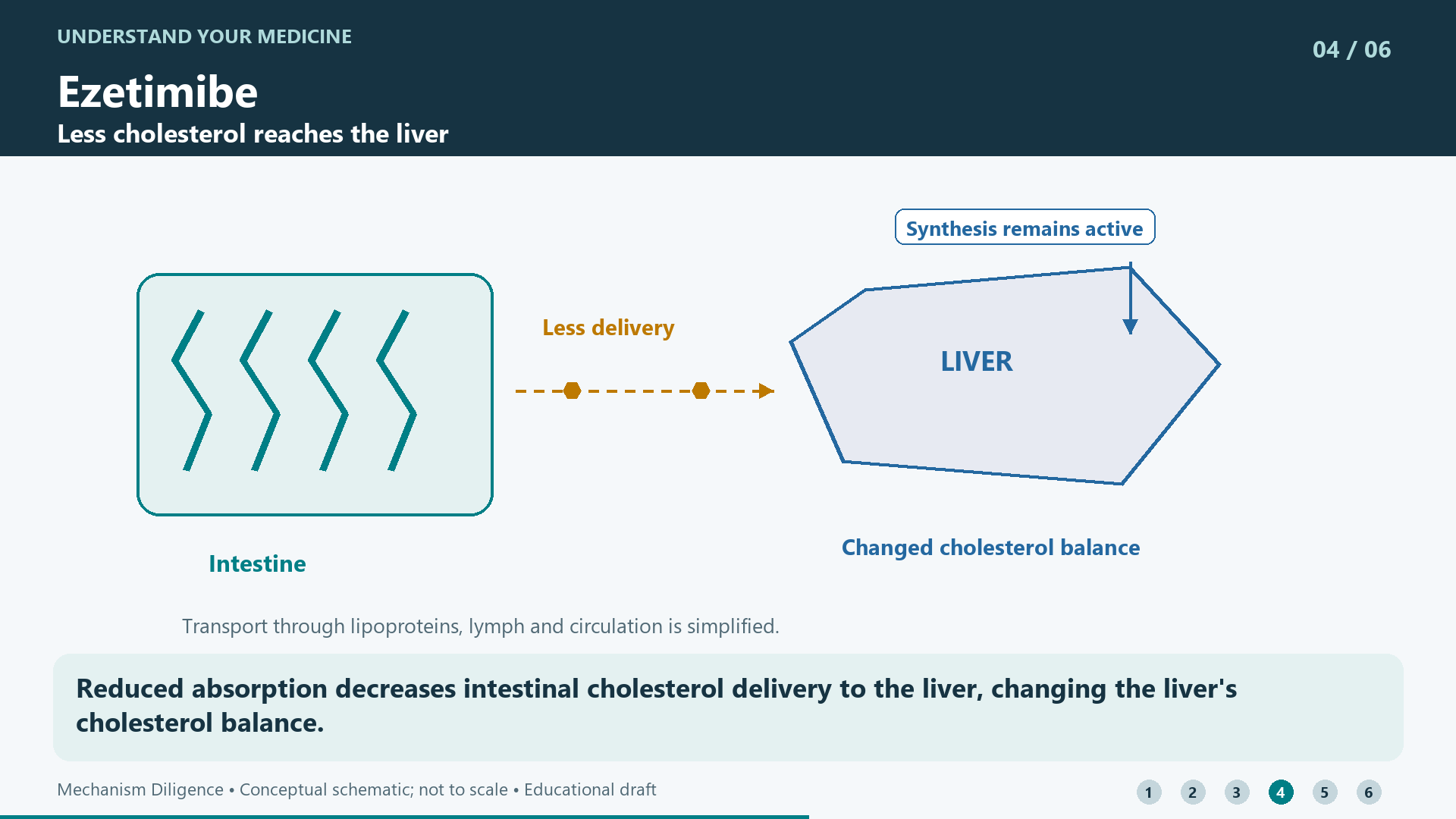
Reduced absorption decreases intestinal cholesterol delivery to the liver, changing the liver's cholesterol balance.
This is an organ-level consequence downstream of the intestinal target. Human studies also show compensatory cholesterol synthesis, so hepatic synthesis remains visible rather than switching off with ezetimibe.
The route compresses lipoprotein assembly, lymph and circulation; organ pools and compensation are qualitative.
- Zetia prescribing information, Organon · Sections 1, 5.2-5.3, 12.1-12.3, 14; label updated November 25, 2025; prescribing information revised February 2024 · U.S. prescribing information; live selected sections checked · checked 2026-10-17
- Sudhop et al. Inhibition of intestinal cholesterol absorption by ezetimibe in humans (2002) · Abstract: randomized crossover study in 18 patients, two-week treatment periods, absorption and synthesis measurements; DOI 10.1161/01.cir.0000034044.95911.dc · Primary human mechanistic clinical study; indexed abstract checked · checked 2026-10-17
- Ezetimibe tablet label: cholesterol-source physiology · Section 12.1 only: dietary and biliary intestinal cholesterol and hepatic synthesis · Older U.S. label used only for physiology; not used for current indications, contraindications or outcome claims · checked 2026-10-17
Chapter 5: More LDL receptors clear blood
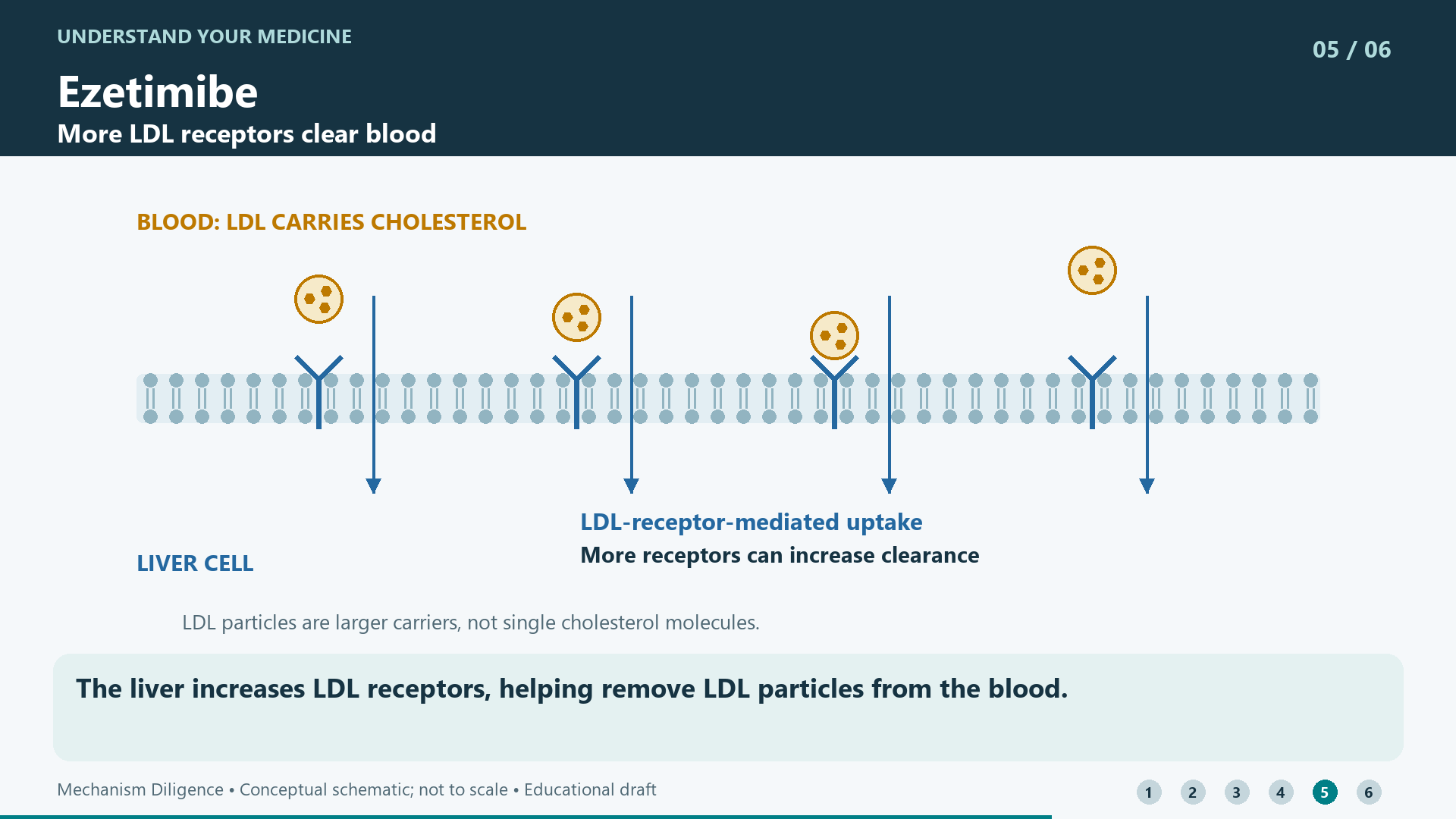
The liver increases LDL receptors, helping remove LDL particles from the blood.
The label connects lower hepatic cholesterol stores with increased LDL receptors and greater blood-cholesterol clearance. LDL is a lipoprotein particle carrying cholesterol; it is not interchangeable with a single free cholesterol molecule.
The feedback is compressed in time. Receptor numbers and clearance rates are not measured values or guaranteed individual responses.
- Zetia prescribing information, Organon · Sections 1, 5.2-5.3, 12.1-12.3, 14; label updated November 25, 2025; prescribing information revised February 2024 · U.S. prescribing information; live selected sections checked · checked 2026-10-17
Chapter 6: Lower LDL is a measured outcome
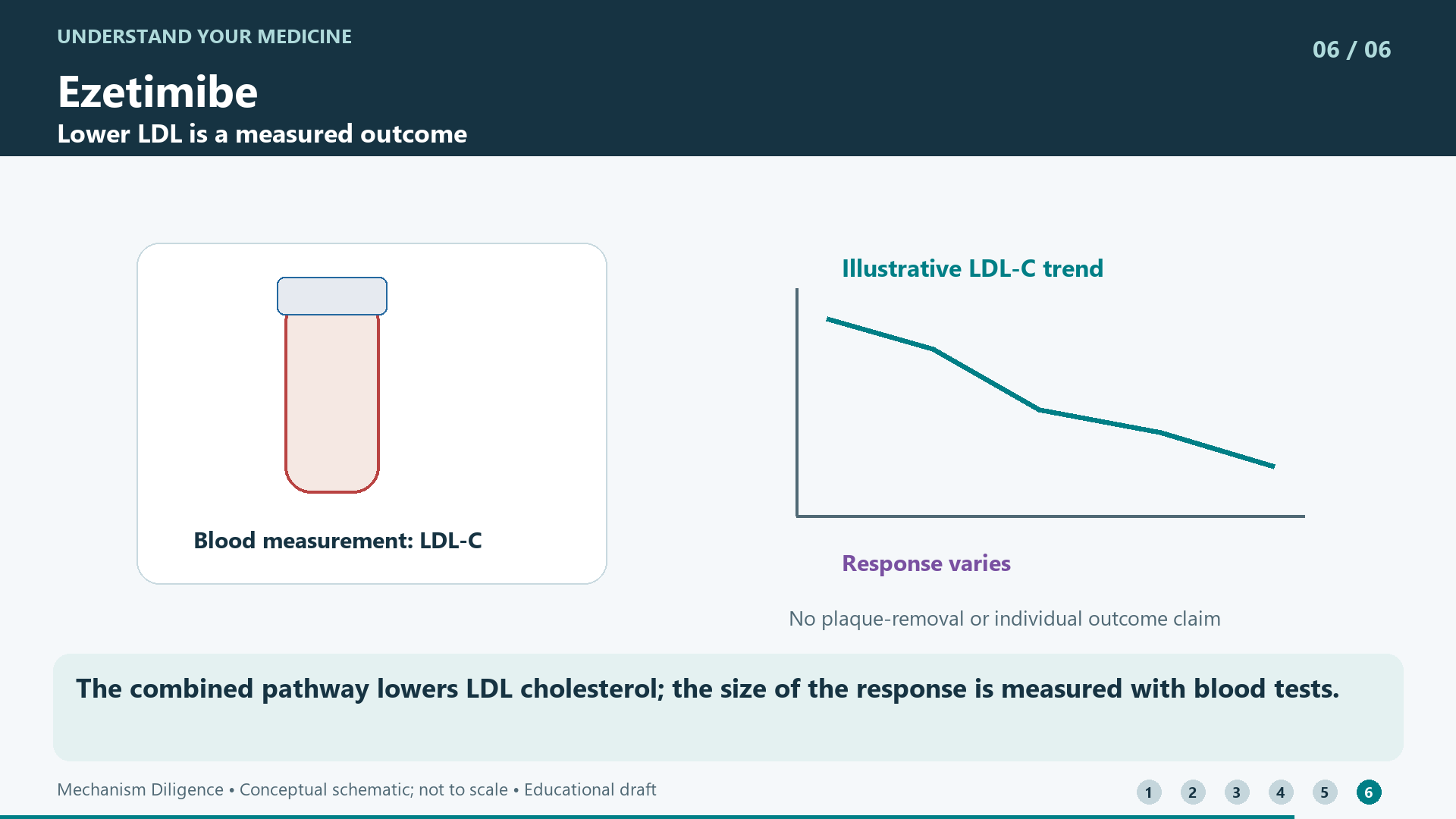
The combined pathway lowers LDL cholesterol; the size of the response is measured with blood tests.
The human absorption study and prescribing information support LDL lowering. The sequence does not infer a particular reduction in heart attacks from a receptor cartoon or claim that existing arterial plaque disappears. Risks, including muscle and liver effects, remain relevant.
A laboratory outcome is distinct from an individual's cardiovascular outcome; this scene does not provide a full benefit-risk assessment.
- Sudhop et al. Inhibition of intestinal cholesterol absorption by ezetimibe in humans (2002) · Abstract: randomized crossover study in 18 patients, two-week treatment periods, absorption and synthesis measurements; DOI 10.1161/01.cir.0000034044.95911.dc · Primary human mechanistic clinical study; indexed abstract checked · checked 2026-10-17
- Zetia prescribing information, Organon · Sections 1, 5.2-5.3, 12.1-12.3, 14; label updated November 25, 2025; prescribing information revised February 2024 · U.S. prescribing information; live selected sections checked · checked 2026-10-17
Sources & scope
Source pages checked 2026-10-12. AI editorial source check; independent clinical review pending.
- Adults and primary hyperlipidemia only; no fixed-combination product guidance.
- No dose, regimen, treatment selection or comparative cardiovascular benefit claims.
- Selective safety information; check the full label and all companion medicines.
- Live HTML section checks are not a retained XML snapshot, comprehensive label comparison or independent clinical review.
DailyMed / NLM ↗ · Organon LLC · page updated 2025-11-25
Zetia reference tablet label; selected sections checked in live HTML. No XML snapshot retained or SPL version inferred.
Patient-language cross-check. Broader monograph does not widen this guide scope.