Medicine reading guide
Famotidine
Prescription acid-reducing medicine
Adults using prescription oral famotidine tablets. Excludes OTC self-treatment, combination products, liquids, injections and children.
Educational information. Independent clinical review pending. This is a selective explanation, not the full prescribing information.
Uses / Symptoms
- GERD and stomach or duodenal ulcers.
Effects
- Less stomach acid.
Side effects
- Headache, dizziness, constipation or diarrhea.
- Serious: allergy, confusion or heart-rhythm problems.
Selected information; not a complete safety list. Full prescribing information and patient guidance ↗
How it works
Famotidine blocks a message that tells stomach cells to release acid. The stomach makes less acid, which can help acid-related symptoms; it does not neutralize acid already there like an antacid.
Perspective answer sources
Section-two answers source-checked October 17, 2026; independent clinical review pending.
Read the mechanism, step by step
Famotidine blocks histamine H2 receptors, reducing the acid secreted by the stomach.
Acid suppression includes resting, nighttime and food-stimulated secretion.
Common questions
What is it for?
Prescription uses include GERD, ulcers and conditions causing excess stomach acid.
How does it work?
It blocks H2 receptors involved in stomach acid secretion.
Must I take it with food?
Take with or without food, following your prescription schedule.
What side effects might I notice?
Headache, dizziness, constipation and diarrhea can occur. Tell your clinician if persistent or severe.
Why does kidney function matter?
Kidney impairment can raise drug levels. Your prescriber may adjust treatment to reduce confusion and heart-rhythm risks.
Can other medicines interact?
Lower acidity can reduce absorption of other medicines. Tizanidine also needs checking; the label advises avoiding this combination.
When should I get help?
Get emergency help for breathing difficulty or face, tongue or throat swelling. Contact your doctor immediately for a new rash or hives.
What if I become confused?
New confusion, hallucinations or marked drowsiness need prompt medical assessment, especially in older adults or kidney impairment.
Does symptom relief rule out serious disease?
Relief does not rule out stomach cancer. Inadequate improvement or early relapse needs reassessment.
Who should avoid it?
Do not use after a serious allergic reaction to famotidine or another H2 blocker.
What about pregnancy or breastfeeding?
Tell your clinician if pregnant, planning pregnancy or breastfeeding before treatment decisions.
Does this cover Pepcid AC or Pepcid Complete?
This guide covers prescription tablets. OTC and combination products have separate instructions; ask your pharmacist to identify yours.
Animation chapters, evidence & visual limits
Adults using prescription oral famotidine tablets for acid-related disease. Excludes OTC self-treatment, combination products, liquids, injections and children.
Educational, source-checked storyboard; independent scientific review is pending. The receptor and pump are distinct schematic proteins. No dose, complete signaling network, clinical ranking against other medicines or comprehensive safety assessment is supplied.
Original conceptual illustrations. AI-assisted editorial source check; independent clinical review pending. No recorded narration.
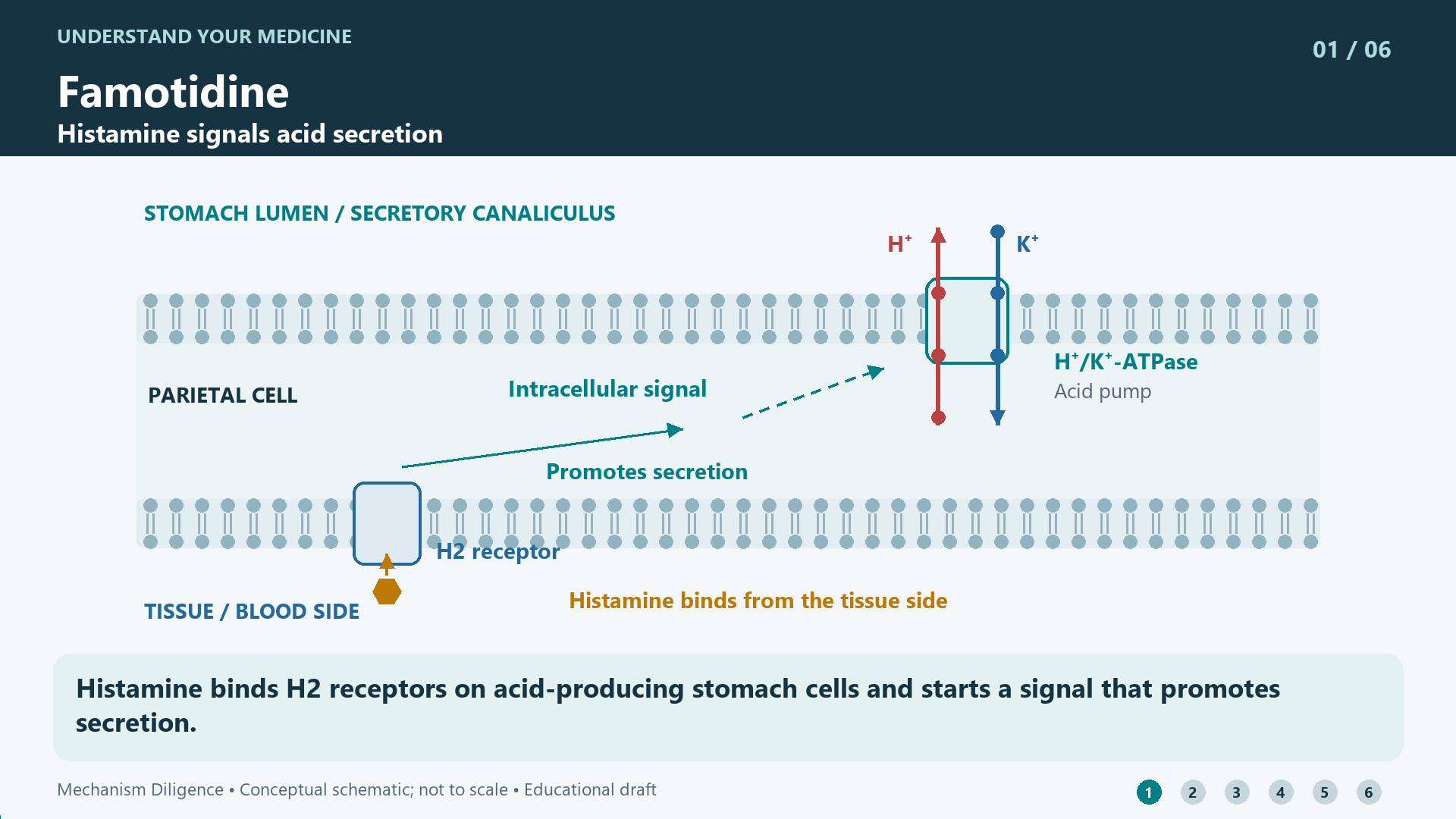
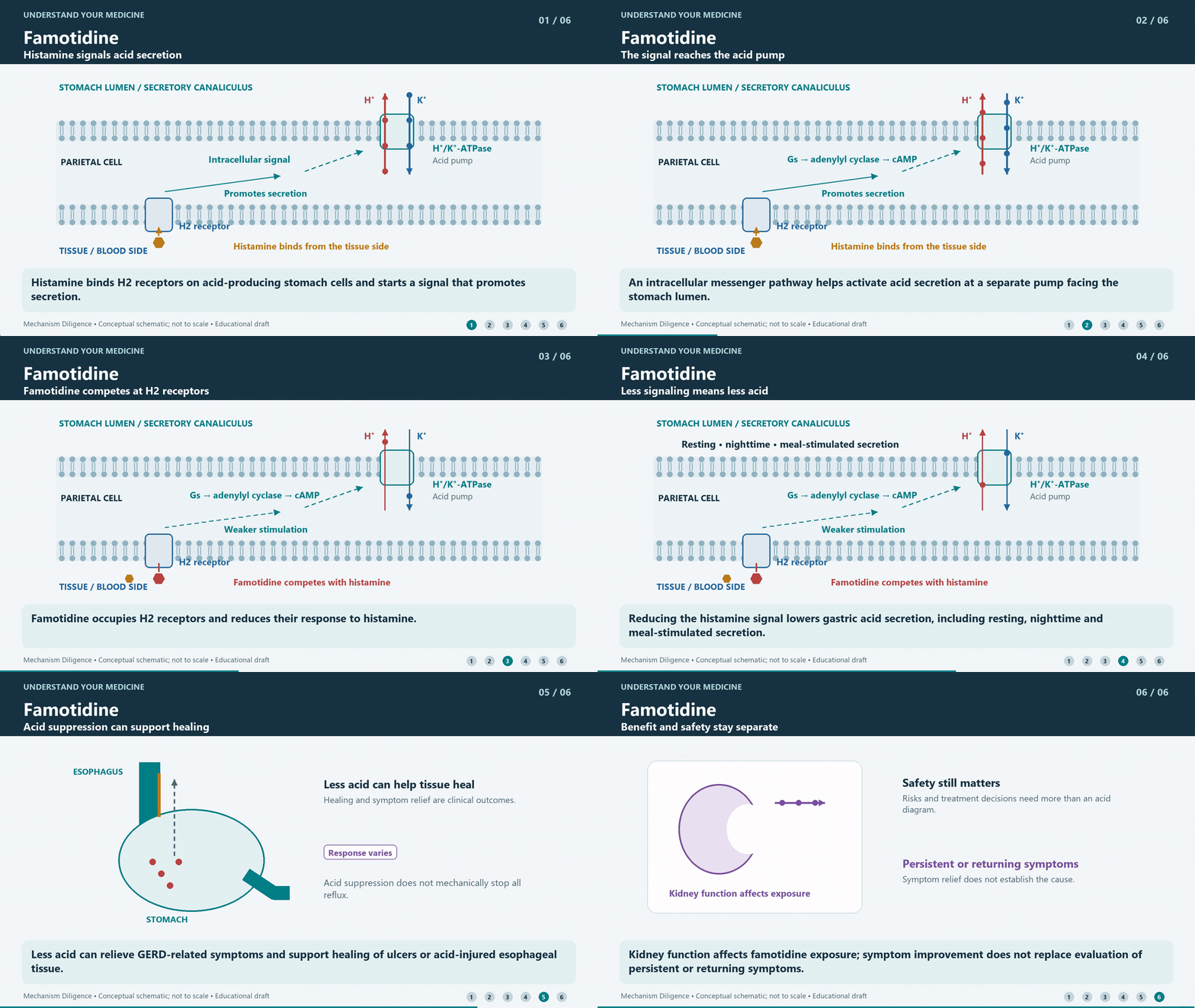
Chapter 1: Histamine signals acid secretion
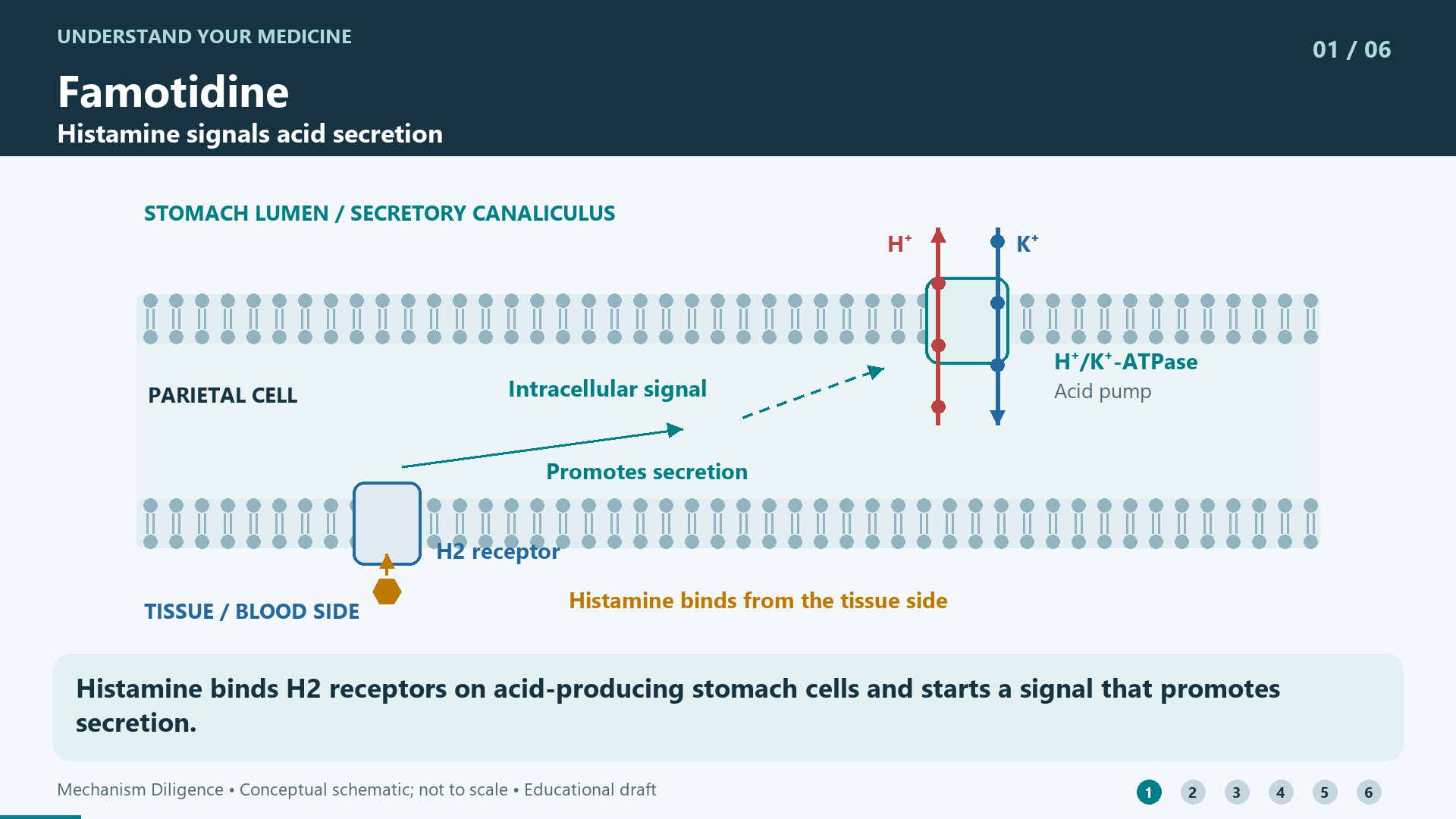
Histamine binds H2 receptors on acid-producing stomach cells and starts a signal that promotes secretion.
Histamine-sensitive signaling is one route controlling parietal-cell function. Research with isolated cells links histamine stimulation to adenylate cyclase activity and acid production; receptor structures support G-protein coupling.
Histamine is one regulatory input. Histamine release and other hormonal or neural inputs are not fully modeled.
- Schepp et al. Effects of hormones and pharmacological antagonists on isolated rat parietal cells (1985) · Abstract: histamine-stimulated adenylate cyclase and acid-production readouts, competitive famotidine inhibition; DOI 10.1016/0167-0115(85)90173-9 · Primary isolated rat-cell study; indexed abstract checked · checked 2026-10-17
- Zhang et al. Structural basis of ligand recognition and activation of the histamine receptor family (2024) · Introduction; Results: Structural determination and G-protein coupling; Methods: Constructs · Primary engineered human receptor structural and functional study; article sections checked · checked 2026-10-17
Chapter 2: The signal reaches the acid pump
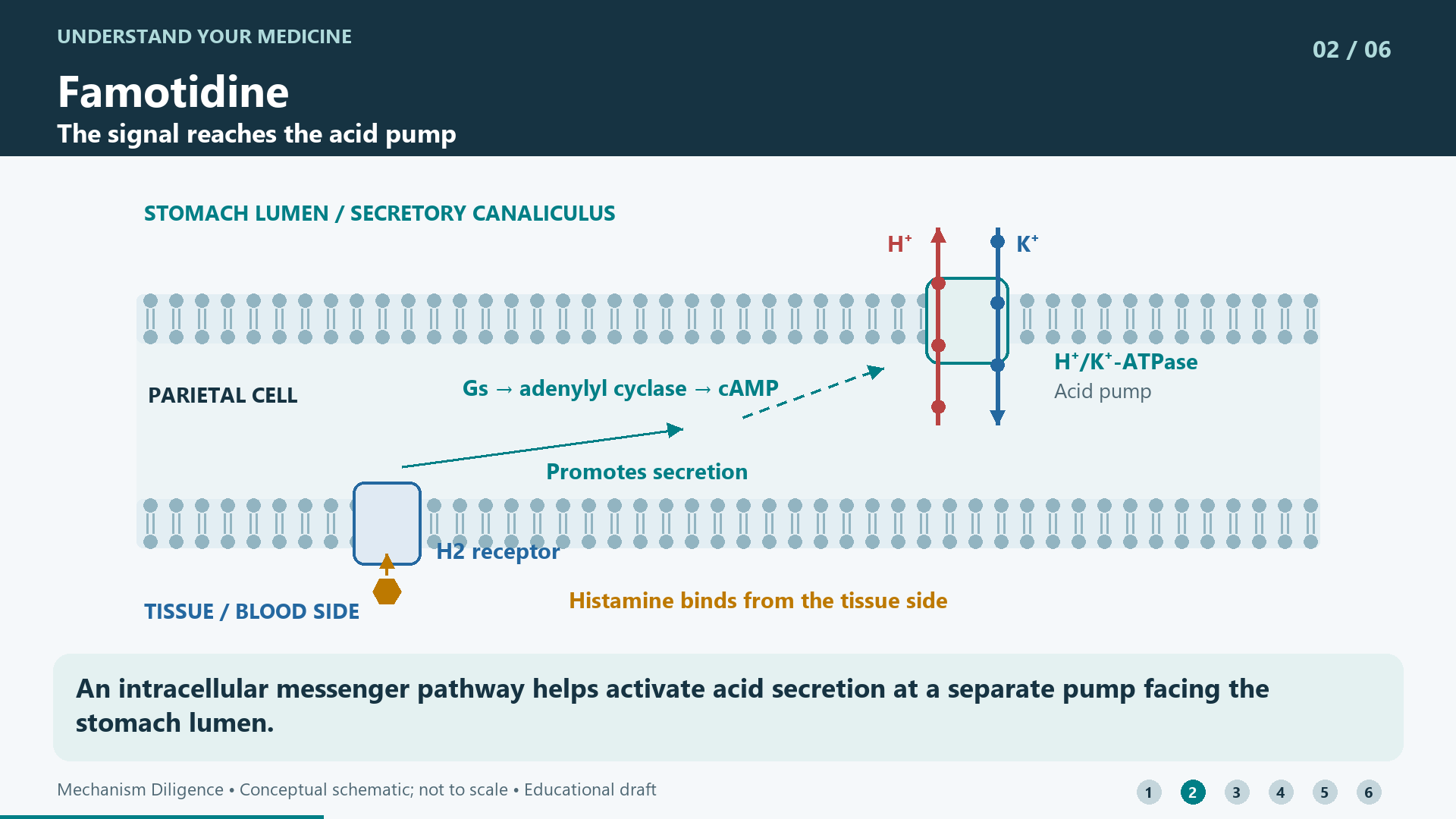
An intracellular messenger pathway helps activate acid secretion at a separate pump facing the stomach lumen.
The teaching pathway emphasizes H2/Gs/adenylate cyclase/cAMP signaling and the final H+/K+-ATPase transport step. It compresses several cellular operations; H2 can couple to additional pathways under experimental conditions.
The dashed relay is a functional summary, not a complete protein-interaction sequence or a claim that cAMP binds the pump directly.
- Schepp et al. Effects of hormones and pharmacological antagonists on isolated rat parietal cells (1985) · Abstract: histamine-stimulated adenylate cyclase and acid-production readouts, competitive famotidine inhibition; DOI 10.1016/0167-0115(85)90173-9 · Primary isolated rat-cell study; indexed abstract checked · checked 2026-10-17
- Zhang et al. Structural basis of ligand recognition and activation of the histamine receptor family (2024) · Introduction; Results: Structural determination and G-protein coupling; Methods: Constructs · Primary engineered human receptor structural and functional study; article sections checked · checked 2026-10-17
- Abe et al. Gastric proton pump with two occluded K+ engineered with sodium pump-mimetic mutations (2021) · Abstract and introduction: gastric H+/K+-ATPase function; DOI 10.1038/s41467-021-26024-1 · Primary structural and biochemical study; indexed excerpts checked · checked 2026-10-17
Chapter 3: Famotidine competes at H2 receptors
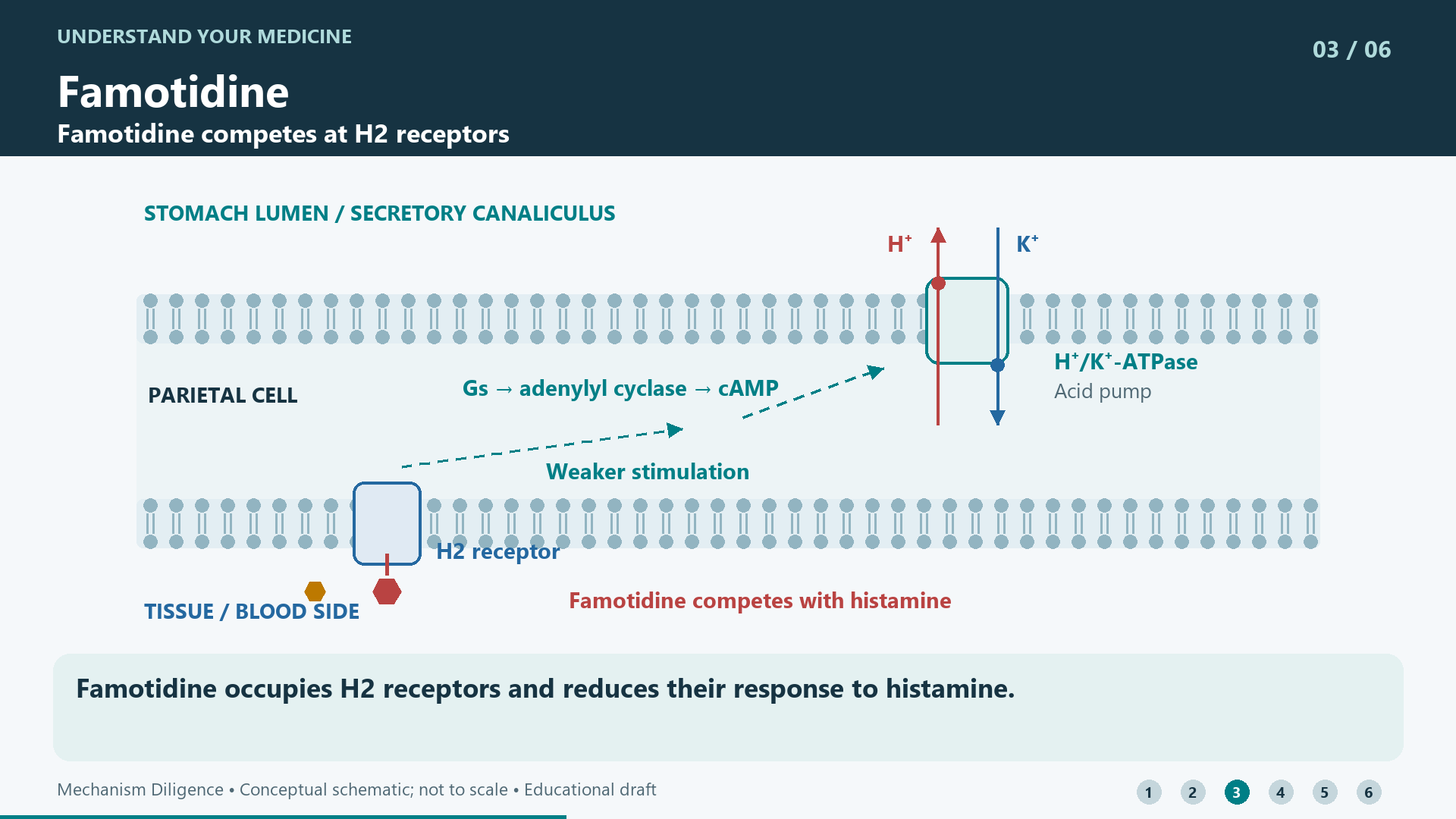
Famotidine occupies H2 receptors and reduces their response to histamine.
The label describes competitive receptor inhibition. Structural research captured famotidine with an engineered inactive H2 receptor, providing direct target-level evidence without establishing a real-time binding movie.
Cartoon occupancy is qualitative. No atomic contact, binding rate or permanent receptor destruction is asserted.
- Famotidine tablets prescribing information, RemedyRepack · Sections 1, 5.1-5.2, 8.6, 12.1-12.3, 14; prescribing information revised September 2025 · U.S. prescribing information; live selected sections checked · checked 2026-10-17
- Robertson et al. Structure determination of inactive-state GPCRs with a universal nanobody (2022) · Abstract and Figure 5 description: engineered H2 receptor-famotidine complex · Primary cryo-EM study; indexed abstract and figure description checked, not coordinates or full methods · checked 2026-10-17
Chapter 4: Less signaling means less acid
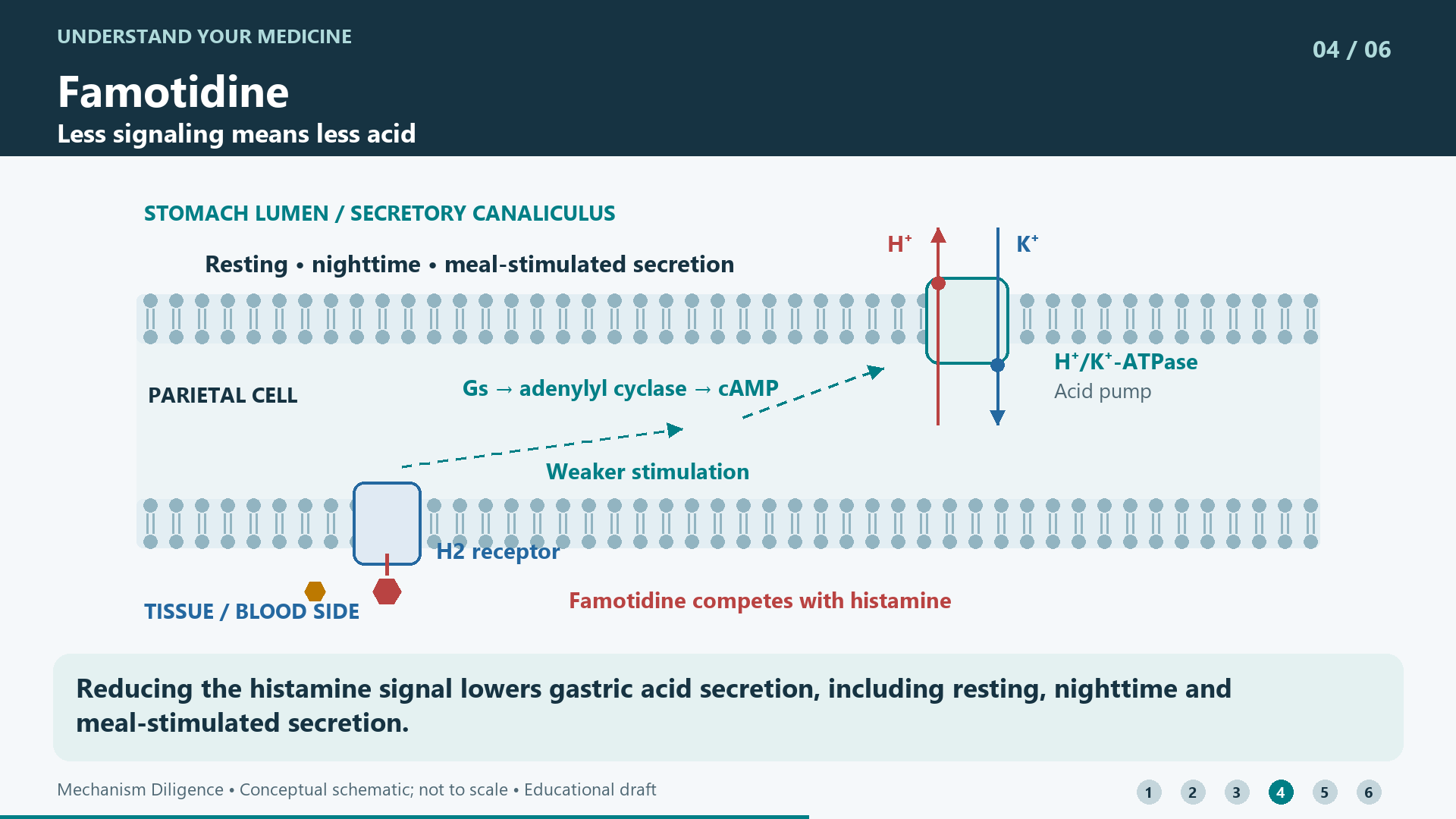
Reducing the histamine signal lowers gastric acid secretion, including resting, nighttime and meal-stimulated secretion.
Clinical pharmacology measurements support reduced gastric secretion under several conditions. Retain residual activity rather than implying that one blocked receptor silences every acid-producing cell.
Particle counts do not encode percentage suppression; response and duration vary.
- Famotidine tablets prescribing information, RemedyRepack · Sections 1, 5.1-5.2, 8.6, 12.1-12.3, 14; prescribing information revised September 2025 · U.S. prescribing information; live selected sections checked · checked 2026-10-17
- Schepp et al. Effects of hormones and pharmacological antagonists on isolated rat parietal cells (1985) · Abstract: histamine-stimulated adenylate cyclase and acid-production readouts, competitive famotidine inhibition; DOI 10.1016/0167-0115(85)90173-9 · Primary isolated rat-cell study; indexed abstract checked · checked 2026-10-17
Chapter 5: Acid suppression can support healing
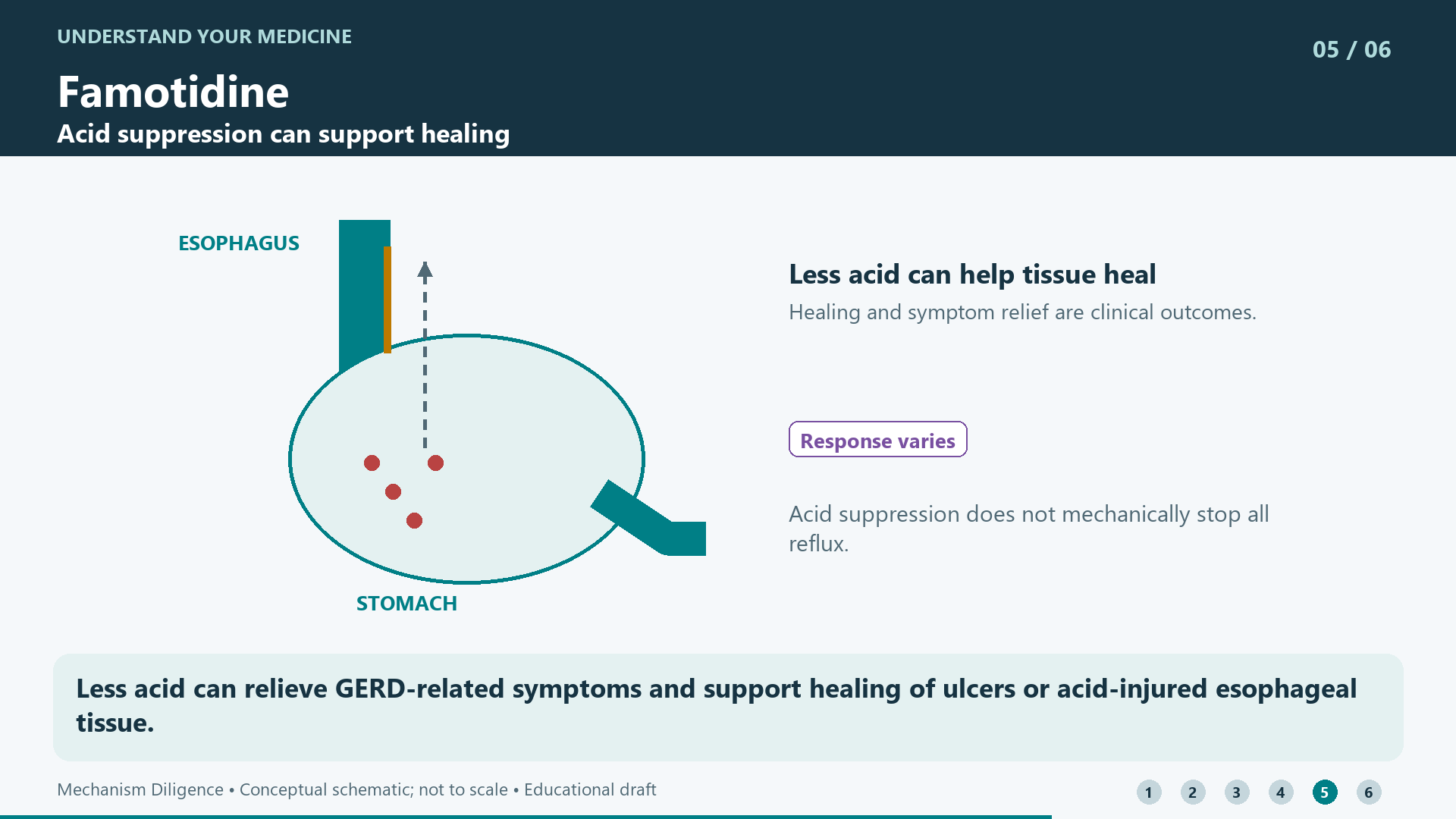
Less acid can relieve GERD-related symptoms and support healing of ulcers or acid-injured esophageal tissue.
The label includes acid-related conditions and clinical healing studies. The clinical panel follows the secretion panel without claiming that target engagement guarantees benefit for an individual.
Symptom improvement does not establish the cause or exclude gastric malignancy; no cure of infection is shown.
- Famotidine tablets prescribing information, RemedyRepack · Sections 1, 5.1-5.2, 8.6, 12.1-12.3, 14; prescribing information revised September 2025 · U.S. prescribing information; live selected sections checked · checked 2026-10-17
Chapter 6: Benefit and safety stay separate
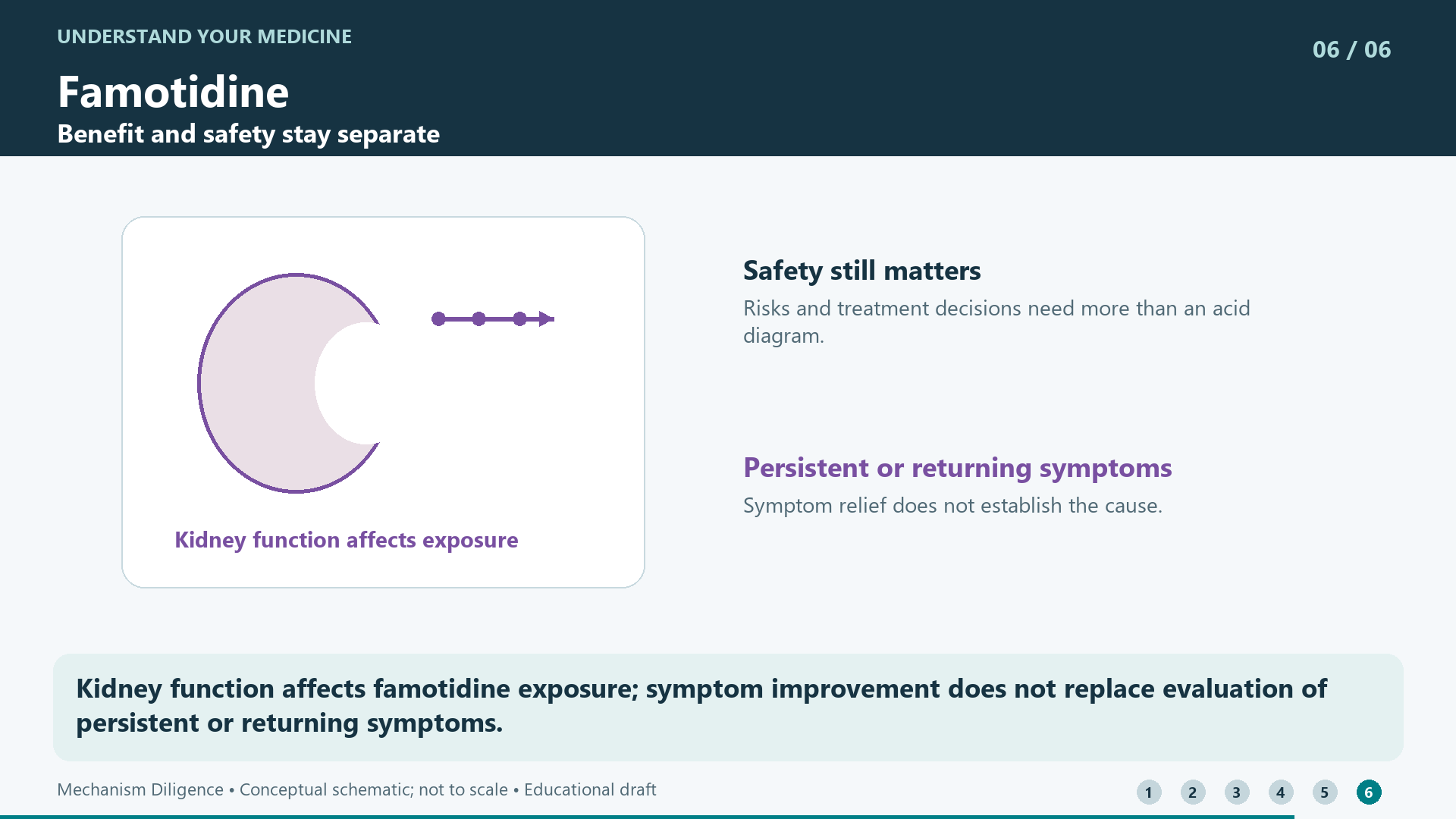
Kidney function affects famotidine exposure; symptom improvement does not replace evaluation of persistent or returning symptoms.
Renal impairment can raise drug exposure and increase risks including central nervous system effects. The final frame separates these safety considerations from the acid-secretion mechanism; the full medicine guide remains necessary.
This is a selected safety context, not a complete list of adverse effects or individualized treatment advice.
- Famotidine tablets prescribing information, RemedyRepack · Sections 1, 5.1-5.2, 8.6, 12.1-12.3, 14; prescribing information revised September 2025 · U.S. prescribing information; live selected sections checked · checked 2026-10-17
Sources & scope
Source pages checked 2026-10-12. AI editorial source check; independent clinical review pending.
- Adult scope only; no dosing or regimen selection.
- Selective safety information; read the full prescribing information.
- Live HTML source check only; no retained XML or manufacturer-label reconciliation.
- Source mapping is not independent clinical review.
DailyMed / NLM ↗ · REMEDYREPACK INC.