Modafinil (Drug class: Wakefulness-promoting agents)
Oral modafinil for adults with excessive sleepiness associated with narcolepsy, obstructive sleep apnea or shift work disorder. It treats sleepiness, not airway obstruction; it is not an approved general-purpose study aid.
Educational draft · independent clinical review pending. Silent mechanism animation available; no recorded narration.
Uses / Symptoms
- Excessive sleepiness with narcolepsy
- Excessive sleepiness with obstructive sleep apnea
- Excessive sleepiness with shift work disorder
Effects
- Can improve wakefulness in adults with these conditions
- Does not treat the blocked airway in sleep apnea
- Does not replace adequate sleep or guarantee safe driving
Side effects
- Headache, nausea, anxiety or insomnia
- Dizziness or stomach upset
- Important risks include serious rash, allergic reactions, psychiatric symptoms and cardiovascular concerns
How does Modafinil work? What is the Mechanism Of Action (MOA)?
Modafinil helps some people stay awake, but scientists do not fully understand how. It slows dopamine recycling in the brain, which is one part of its known activity. It does not replace sleep or treat the blocked airway in sleep apnea.
The mechanism, step by step
- Dopamine participates in brain signaling
Dopamine is one of several chemical messengers involved in wakefulness.
- DAT normally takes dopamine back up
The dopamine transporter helps recycle dopamine into nerve cells.
- Modafinil inhibits dopamine reuptake
Target-binding and human imaging evidence support this action.
- Wakefulness may improve
The full connection between these actions and wakefulness remains uncertain; other sleep treatment is still needed.
Questions & Answers (FAQ)
How does Modafinil work?
Modafinil helps some people stay awake, but scientists do not fully understand how. It slows dopamine recycling in the brain, which is one part of its known activity. It does not replace sleep or treat the blocked airway in sleep apnea.
What is modafinil approved for?
US labeling covers excessive sleepiness in adults associated with narcolepsy, obstructive sleep apnea and shift work disorder. It is not an approved general-purpose energy booster or study aid.
Does it replace CPAP or treat sleep apnea?
No. It treats excessive sleepiness, not the underlying airway obstruction. Continue the breathing treatment prescribed for sleep apnea; modafinil is not a substitute for it.
Does taking it mean I can drive safely?
Not necessarily. Sleepiness may persist despite treatment. The care team should reassess alertness, and driving or hazardous activity should be avoided when sleepiness makes it unsafe.
What side effects can occur?
Headache, nausea, anxiety, nervousness, insomnia, dizziness and stomach upset are among reported common effects. Report troublesome symptoms to the prescriber.
Why is a new rash important?
Rare, serious skin reactions can occur, and an early rash cannot reliably be judged harmless. The label advises stopping at the first rash unless it is clearly unrelated; contact a clinician promptly, and seek emergency help for breathing trouble, swelling or severe blistering.
Can modafinil affect hormonal contraception?
It can reduce the effectiveness of steroidal hormonal contraceptives. The US label recommends an alternative or additional method during treatment and for one month after stopping; ask a clinician which approach fits the specific contraceptive.
What mood or behavioral changes matter?
New or worsening psychiatric symptoms can occur, including agitation, mania, hallucinations or suicidal thinking. Contact the prescriber promptly; immediate danger needs emergency help.
Is modafinil a controlled medicine?
Yes. It is a Schedule IV controlled substance in the US and has abuse potential. It should only be used as prescribed and not shared.
Is this guide about treatment for children?
No. Modafinil is not approved for pediatric use in the US label. Pediatric studies reported serious rash, so adult indications must not be extended to children from this page.
Is modafinil the same as armodafinil?
No. Modafinil contains both R and S enantiomers; armodafinil is the R enantiomer. They are distinct medicines, and this page should not be used to infer interchangeable prescriptions.
What about pregnancy or other medicines?
Discuss pregnancy plans and the complete medicine list with the care team. The label describes developmental toxicity concerns and clinically important enzyme interactions; it does not establish that use during pregnancy is safe.
Online stores and Pharmacies (Buy)
Modafinil is prescription-only and a US Schedule IV controlled substance. Obtain it through a licensed prescriber and pharmacy; this guide makes no price, availability or no-prescription access claims.
No live price, stock or individual eligibility is verified here.
Animation chapters, evidence & visual limits
US oral modafinil for excessive sleepiness associated with adult narcolepsy, obstructive sleep apnea or shift work disorder. Educational draft; independent clinical review pending.
Network drawings are conceptual. PET findings are not real-time neurotransmitter movies. No cognitive-enhancement, sleep-replacement, airway-treatment or guaranteed-alertness claim.
Original conceptual illustrations. AI-assisted editorial source check; independent clinical review pending. No recorded narration.
Chapter 1: Wakefulness uses many networks
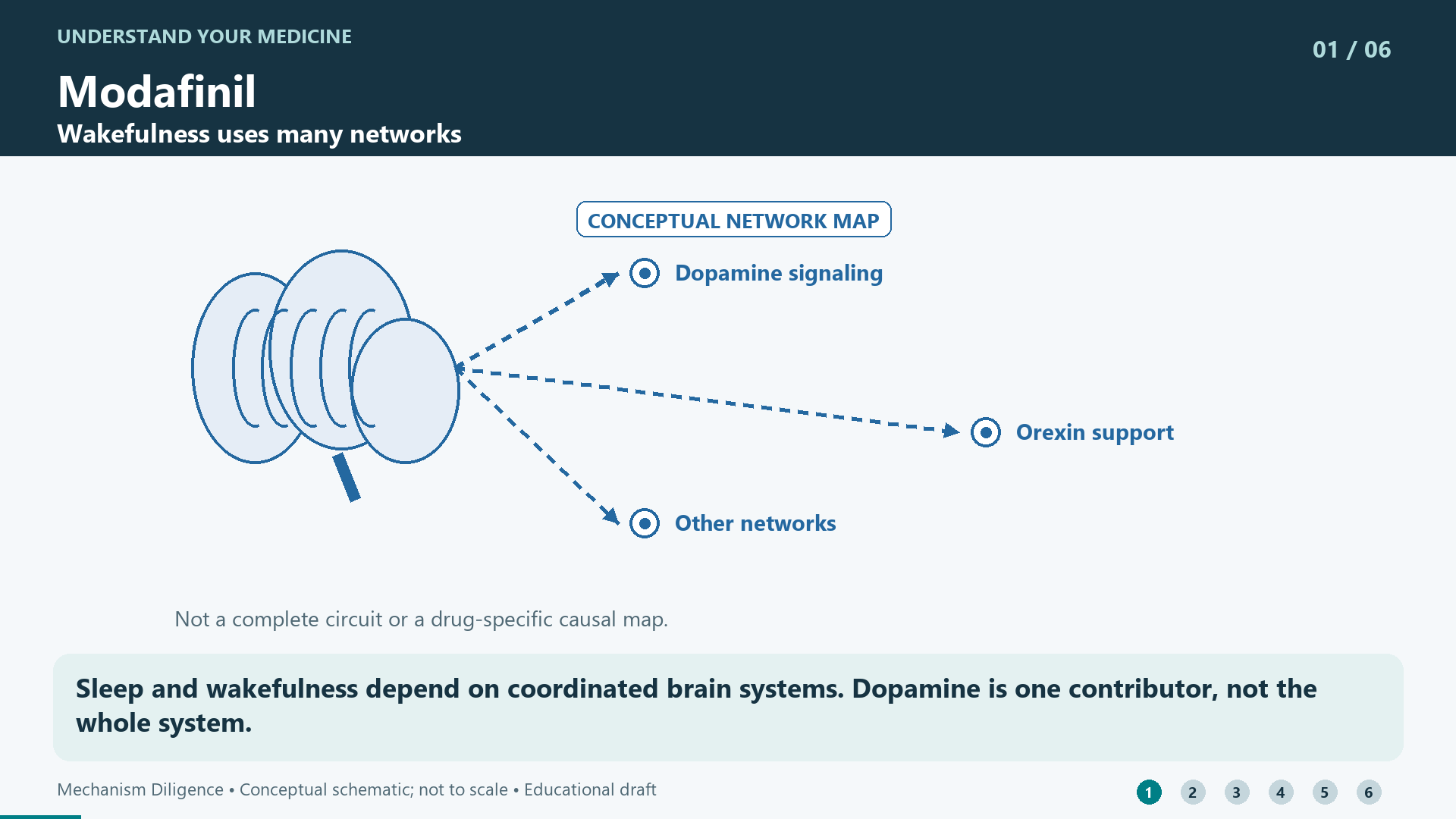
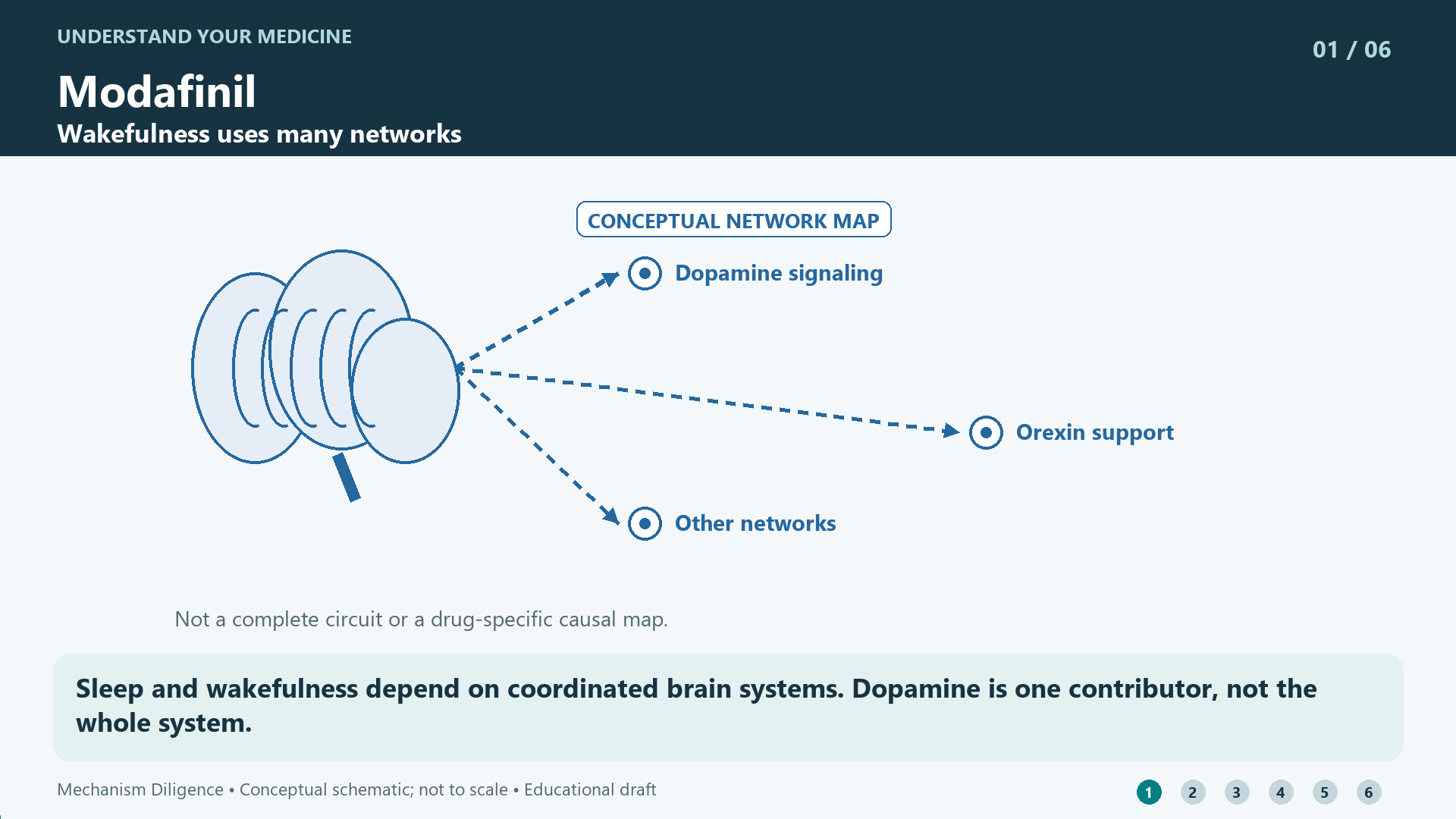
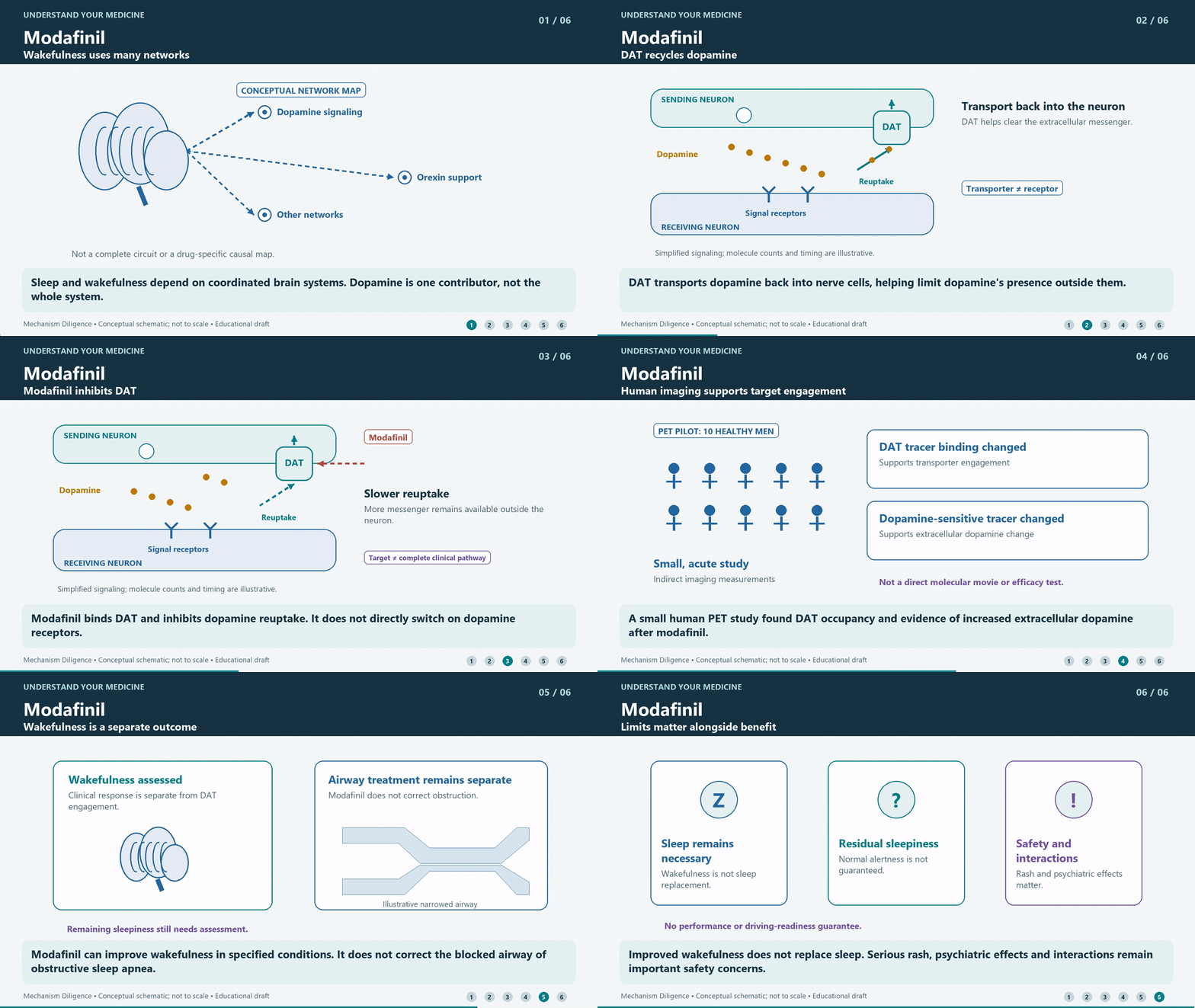
Sleep and wakefulness depend on coordinated brain systems. Dopamine is one contributor, not the whole system.
Present brain-state regulation before the drug. The existence of multiple signaling systems is crucial: DAT pharmacology should not become a claim that all sleepiness is caused by low dopamine.
The network map is conceptual, not a complete anatomical circuit or explanation of every cause of sleepiness.
- NIH: Narcolepsy · Overview, sleep-wake state regulation and hypocretin/orexin · Official neuroscience and condition information · checked 2026-10-17
- Modafinil tablets US prescribing information · Sections 1, 5.1–5.7, 7, 12.1 and 14; DailyMed update 2026-09-03; PI revised 2/2024; mechanism rechecked directly · US product label · checked 2026-10-17
Chapter 2: DAT recycles dopamine
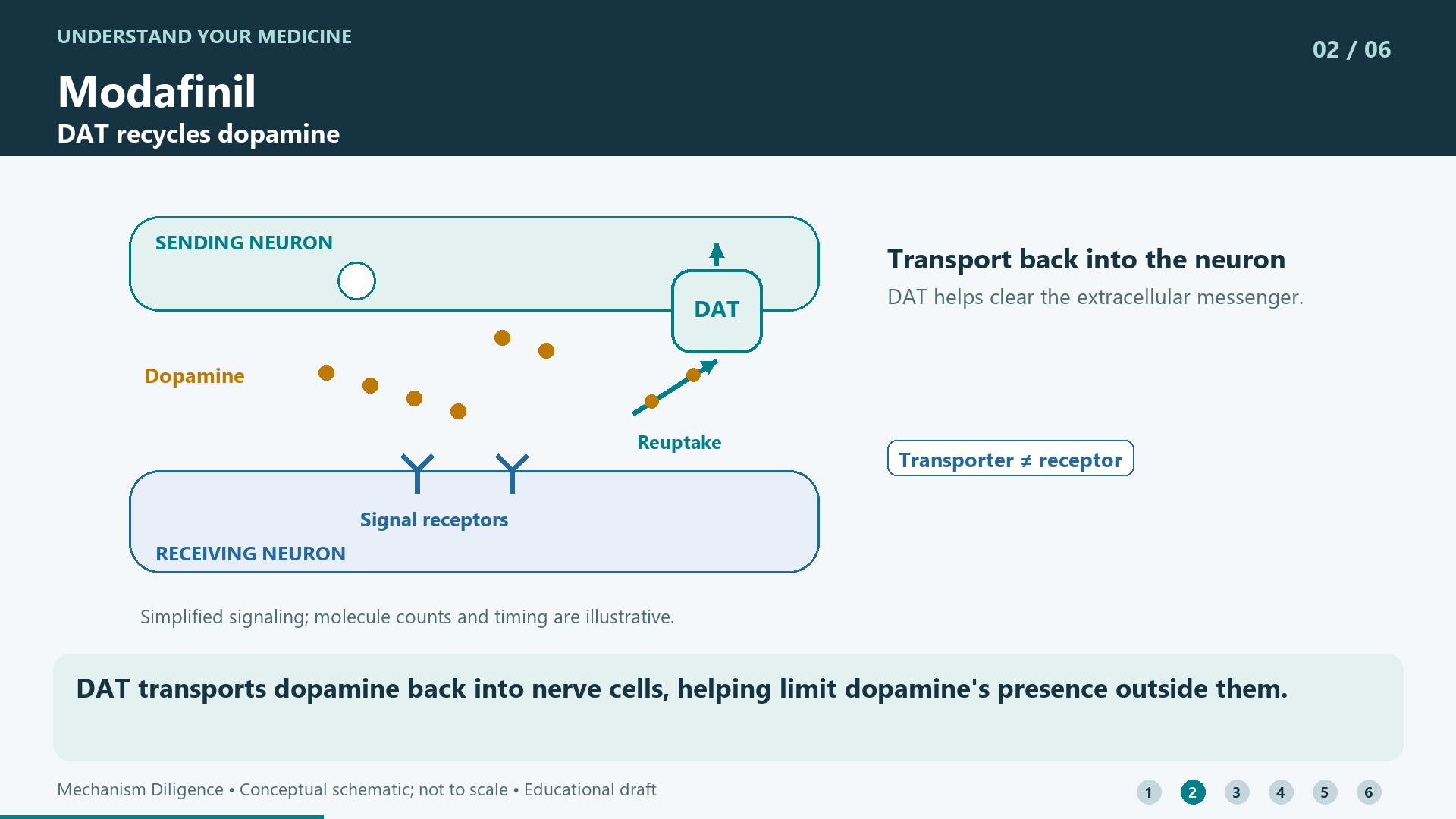
DAT transports dopamine back into nerve cells, helping limit dopamine's presence outside them.
Keep dopamine transporter DAT distinct from dopamine receptors. Reuptake controls extracellular availability; it is not equivalent to shutting down every signal or removing dopamine from the entire brain.
Simplified local signaling; molecule numbers, timing and uptake fractions are illustrative.
- Volkow et al. (2009): Dopamine and DAT in the male human brain · Abstract; pilot PET study, ten healthy men; dopamine-sensitive and DAT radioligands · Primary human target-engagement study · checked 2026-10-17
Chapter 3: Modafinil inhibits DAT
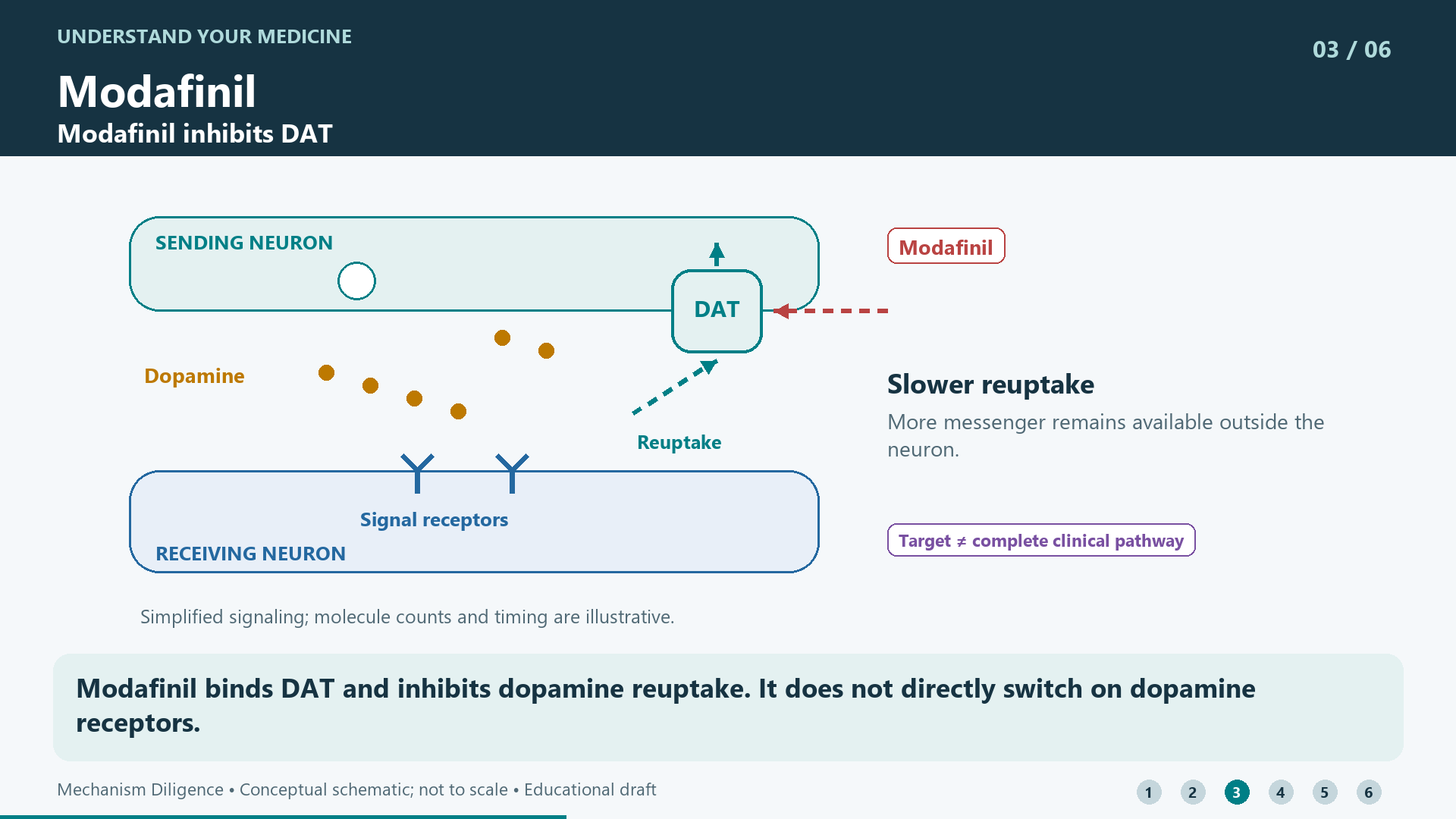
Modafinil binds DAT and inhibits dopamine reuptake. It does not directly switch on dopamine receptors.
The label identifies DAT binding in vitro while leaving the full wake-promoting mechanism unresolved. Do not depict modafinil as a dopamine replacement or a direct receptor agonist.
Known target action is not a complete causal map of clinical wakefulness.
- Modafinil tablets US prescribing information · Sections 1, 5.1–5.7, 7, 12.1 and 14; DailyMed update 2026-09-03; PI revised 2/2024; mechanism rechecked directly · US product label · checked 2026-10-17
- Volkow et al. (2009): Dopamine and DAT in the male human brain · Abstract; pilot PET study, ten healthy men; dopamine-sensitive and DAT radioligands · Primary human target-engagement study · checked 2026-10-17
Chapter 4: Human imaging supports target engagement
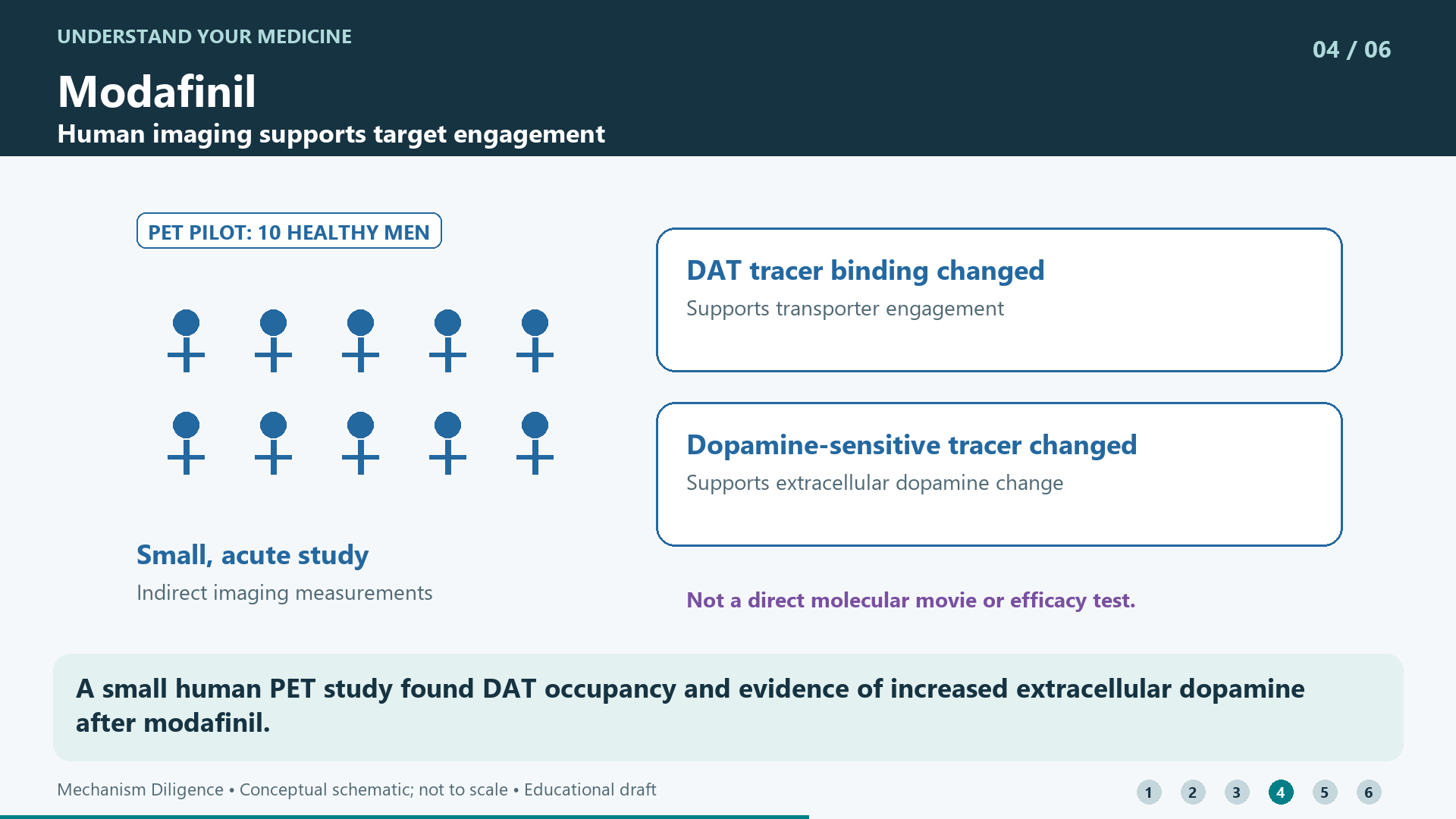
A small human PET study found DAT occupancy and evidence of increased extracellular dopamine after modafinil.
The pilot involved ten healthy men. Changes in radioligand binding supported transporter occupancy and extracellular dopamine increases. This is acute, region-level evidence rather than a direct movie of molecules in a synapse.
Small male-only healthy-volunteer pilot; indirect imaging measures do not establish all therapeutic pathways or generalize to every patient.
- Volkow et al. (2009): Dopamine and DAT in the male human brain · Abstract; pilot PET study, ten healthy men; dopamine-sensitive and DAT radioligands · Primary human target-engagement study · checked 2026-10-17
Chapter 5: Wakefulness is a separate outcome
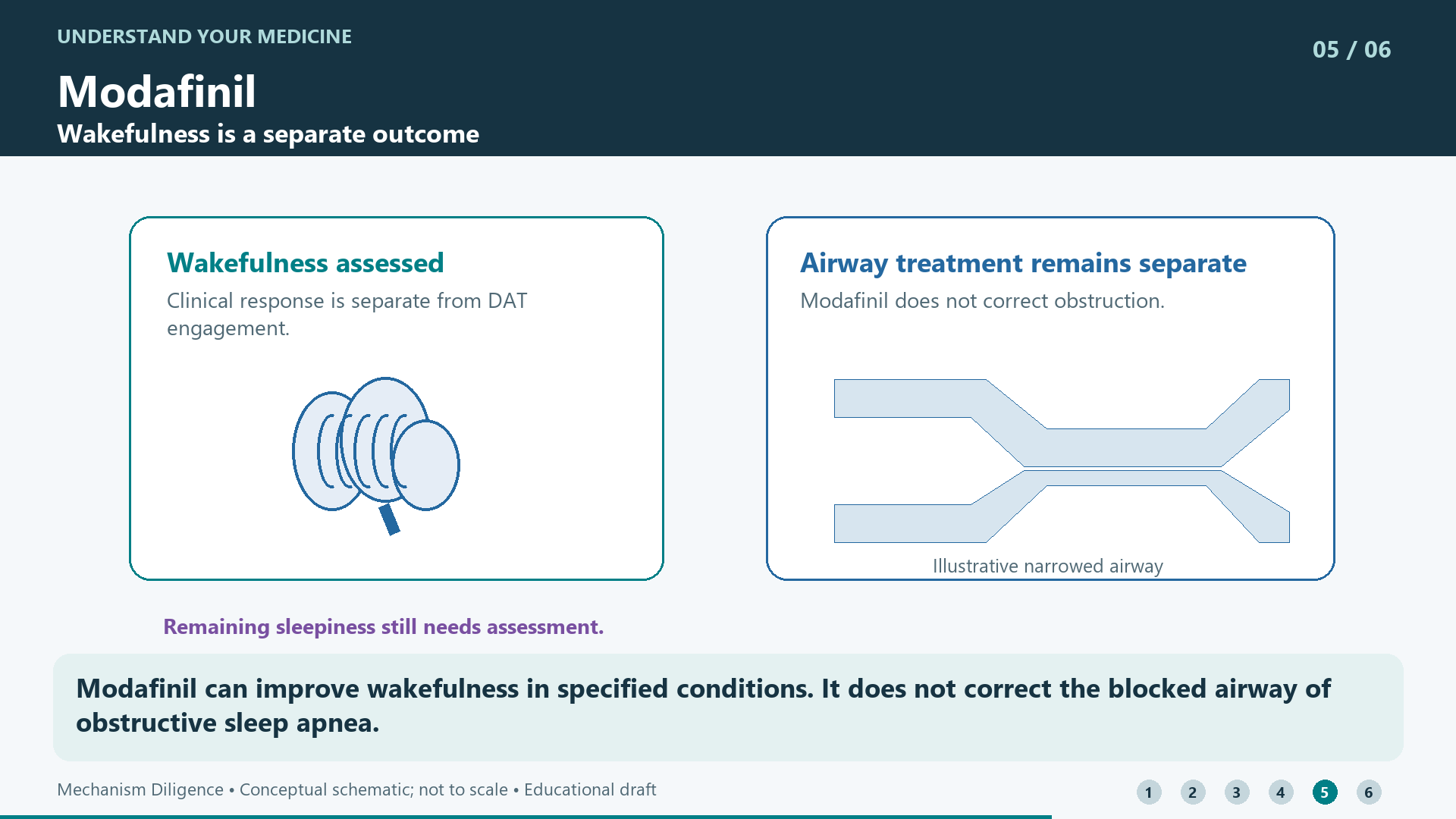
Modafinil can improve wakefulness in specified conditions. It does not correct the blocked airway of obstructive sleep apnea.
Clinical sleepiness outcomes require assessment separately from target engagement. For OSA, the underlying obstruction and its treatment remain a distinct clinical problem.
The animation does not establish normal alertness, cure sleep apnea or endorse use outside labeled settings.
- Modafinil tablets US prescribing information · Sections 1, 5.1–5.7, 7, 12.1 and 14; DailyMed update 2026-09-03; PI revised 2/2024; mechanism rechecked directly · US product label · checked 2026-10-17
Chapter 6: Limits matter alongside benefit
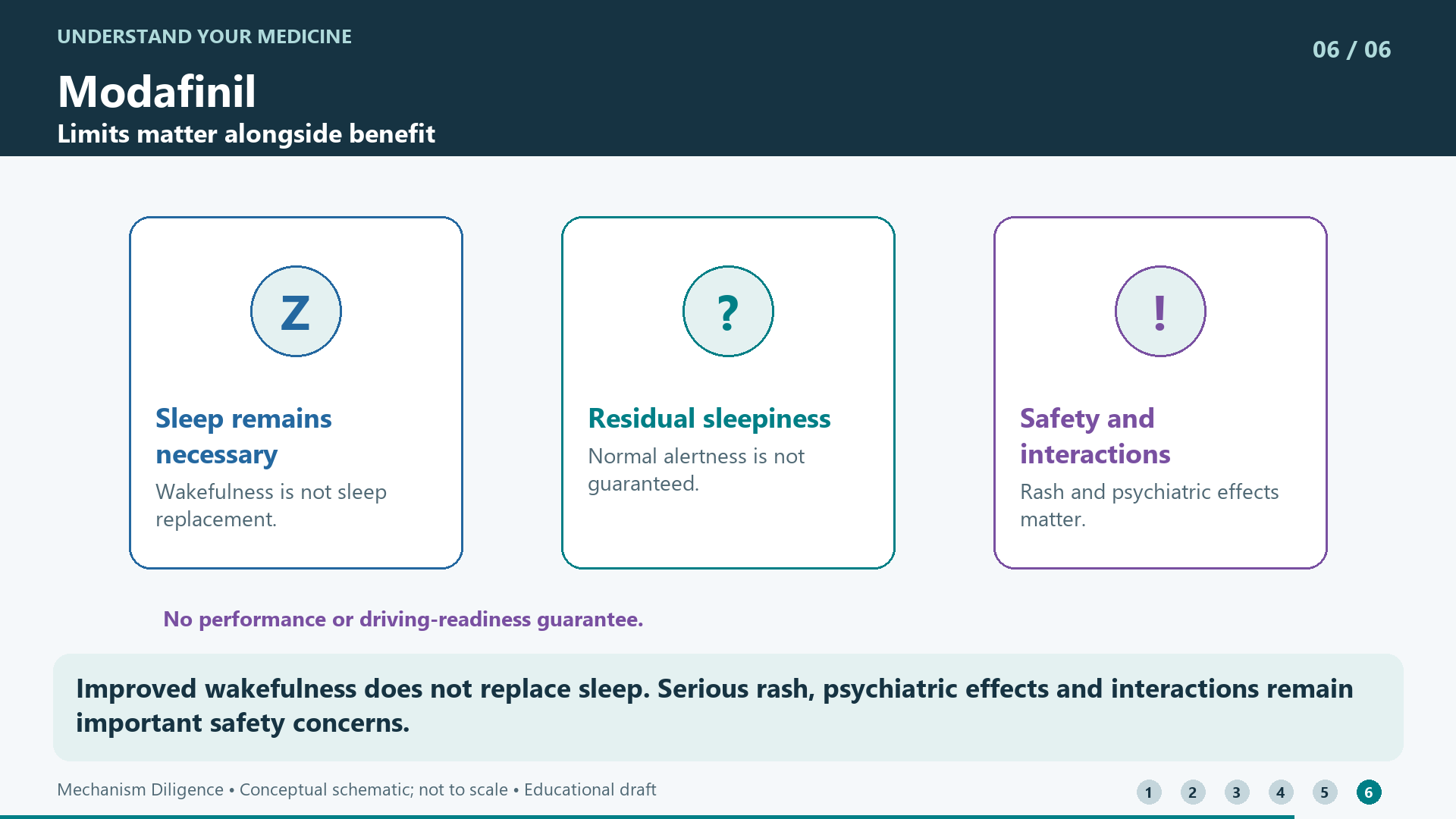
Improved wakefulness does not replace sleep. Serious rash, psychiatric effects and interactions remain important safety concerns.
Safety monitoring and sleepiness response are separate. The product information includes persistent sleepiness and serious hypersensitivity warnings; clinical benefit does not erase those risks.
Selected safety overview; no individualized advice or complete contraindication list.
- Modafinil tablets US prescribing information · Sections 1, 5.1–5.7, 7, 12.1 and 14; DailyMed update 2026-09-03; PI revised 2/2024; mechanism rechecked directly · US product label · checked 2026-10-17
References & Sources
Source pages checked October 16, 2026. AI-assisted editorial source checking is not independent clinical review. Sources support the summary, mechanism, safety and access information; references are also kept beside each question.
- DailyMed: modafinil tablets — US prescribing information ↗ · 1; 5–9; 11–12; Medication Guide. DailyMed updated September 3, 2026; prescribing information revised February 2024; checked October 16, 2026.
- MedlinePlus: modafinil ↗ · Uses, precautions, sleep and breathing treatments; checked October 16, 2026.
- Volkow et al. (2009): modafinil, dopamine and dopamine transporters in the human brain ↗ · Primary PET pilot study in 10 healthy men; target engagement, not proof of the complete therapeutic pathway; checked October 16, 2026.
Selective US-label-based information, not a complete safety list or a personal treatment recommendation. Do not change treatment based on this page; use the product-specific label and your care team's advice.