Medicine reading guide
Ondansetron
Medicine to prevent nausea and vomiting
Adults using standard prescription oral ondansetron tablets for labeled chemotherapy, radiotherapy or postoperative prevention. Excludes dissolving tablets (ODT), oral film, liquid, injections, children and off-label uses.
Educational information. Independent clinical review pending. This is a selective explanation, not the full prescribing information.
Uses / Symptoms
- Prevention around chemotherapy, radiation or surgery.
Effects
- Blocks serotonin signals involved in vomiting.
Side effects
- Headache, constipation or tiredness.
- Serious: abnormal heart rhythm, allergy or serotonin syndrome.
Selected information; not a complete safety list. Full prescribing information and patient guidance ↗
How it works
Ondansetron blocks a serotonin signal involved in triggering vomiting. It acts at receptors associated with the gut and brain, helping prevent nausea and vomiting in certain treatment or surgery settings.
Perspective answer sources
Section-two answers source-checked October 17, 2026; independent clinical review pending.
Read the mechanism, step by step
Ondansetron blocks serotonin 5-HT3 receptors found on gut-associated nerves and in the brain.
The label does not establish whether its anti-vomiting effect acts mainly at one site or both.
Common questions
What is it for?
It helps prevent nausea and vomiting related to cancer treatment or surgery.
How does it work?
It blocks serotonin at 5-HT3 receptors involved in vomiting signals.
How do I take this form?
Follow the prescribed timing for your treatment. This guide covers standard tablets, not tablets dissolved on the tongue.
What side effects might I notice?
Headache, constipation and tiredness can occur. Report persistent or severe symptoms.
Can other medicines interact?
Never combine with apomorphine. Other serotonin-active or heart-rhythm medicines need a pharmacist or prescriber check.
Why might I need a heart check?
Avoid with congenital long QT syndrome. Heart disease, low potassium or magnesium, and certain medicines may require ECG monitoring.
When should I get help?
Get urgent medical help for chest pain, fainting, breathing difficulty, swelling of the throat or an irregular heartbeat.
What symptoms could mean serotonin syndrome?
Agitation or confusion with fever, sweating, stiff or twitching muscles can signal serotonin syndrome. Stop taking ondansetron and seek immediate medical help.
Does it fix a blocked bowel?
It does not restart a blocked bowel and may mask worsening bowel inactivity. Promptly report reduced bowel activity or abdominal swelling.
Does liver disease affect treatment?
Severe liver impairment needs a restricted regimen chosen by your prescriber.
What about pregnancy or breastfeeding?
Discuss pregnancy, planned pregnancy or breastfeeding with your clinician. This guide does not evaluate use for pregnancy-related nausea.
Who should avoid it?
Do not take it after an allergic reaction to ondansetron or an ingredient in your tablets.
Animation chapters, evidence & visual limits
Adults using standard prescription oral ondansetron tablets for labeled chemotherapy, radiotherapy or postoperative nausea/vomiting prevention. Excludes ODT, film, liquid, injections, children and off-label uses.
Educational, source-checked storyboard; independent scientific review is pending. Chemotherapy-associated serotonin release is an example, not a universal explanation for nausea. The cartoon is neither a neural circuit reconstruction nor a complete safety guide.
Original conceptual illustrations. AI-assisted editorial source check; independent clinical review pending. No recorded narration.
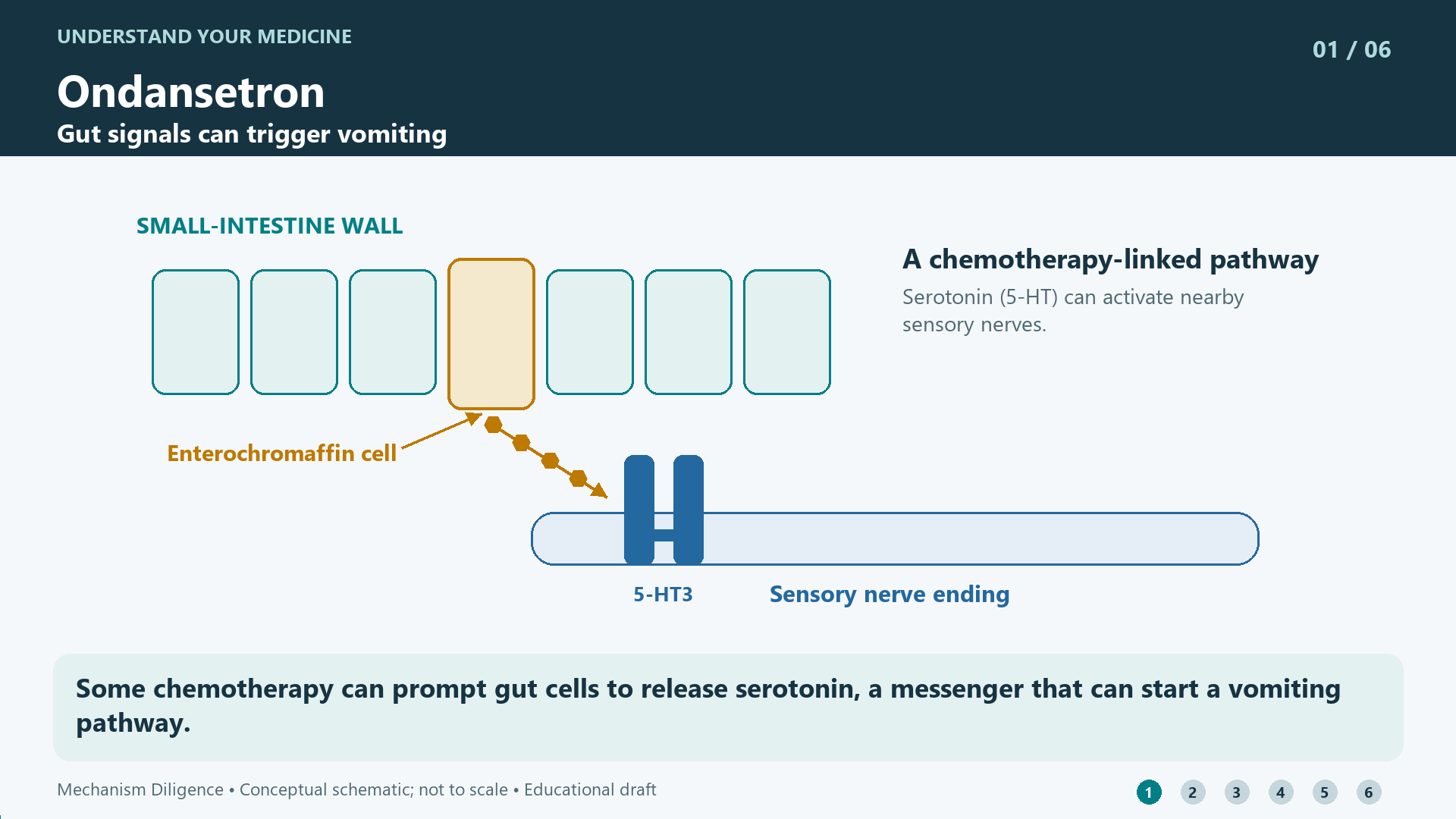
Chapter 1: Gut signals can trigger vomiting
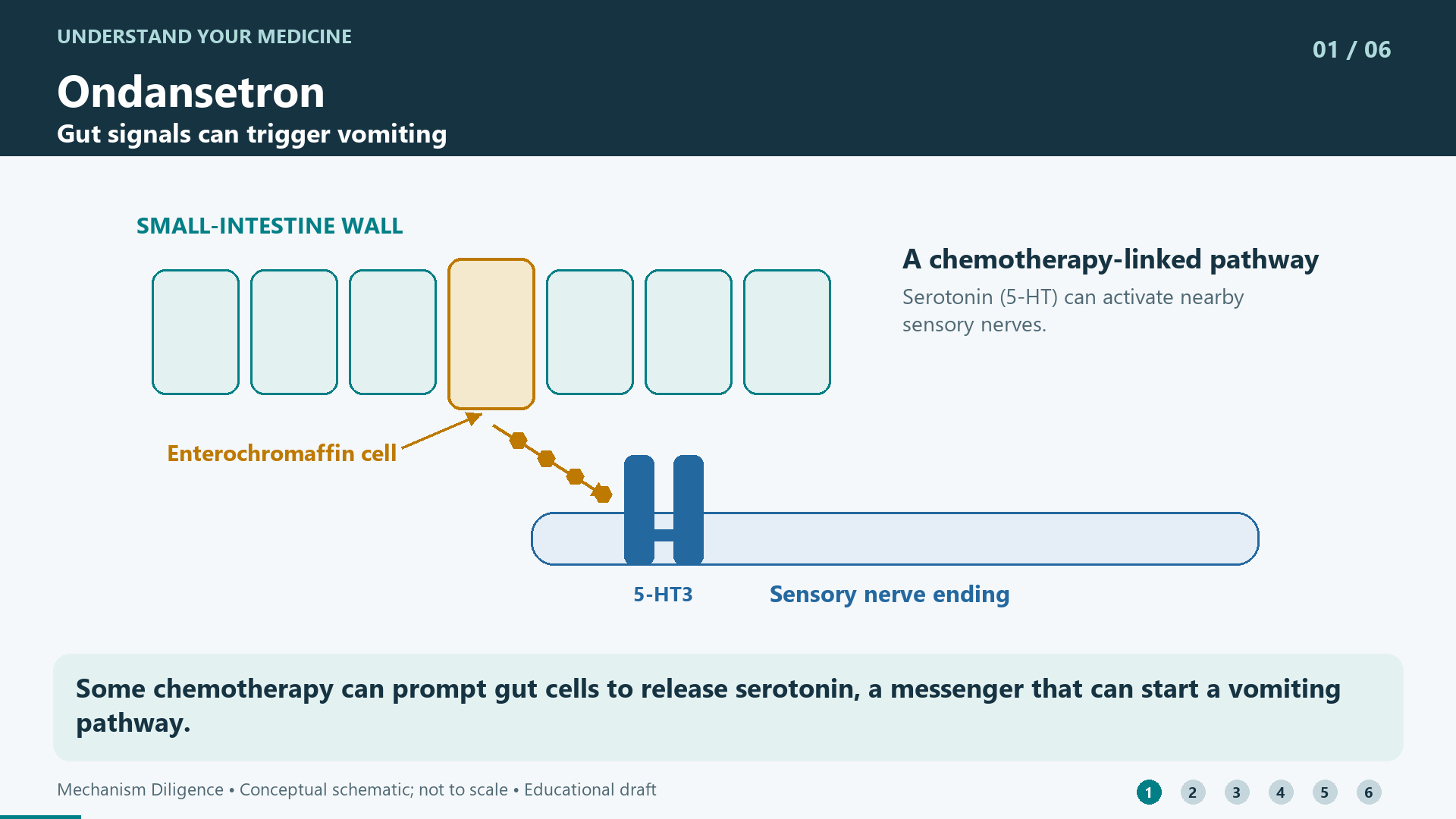
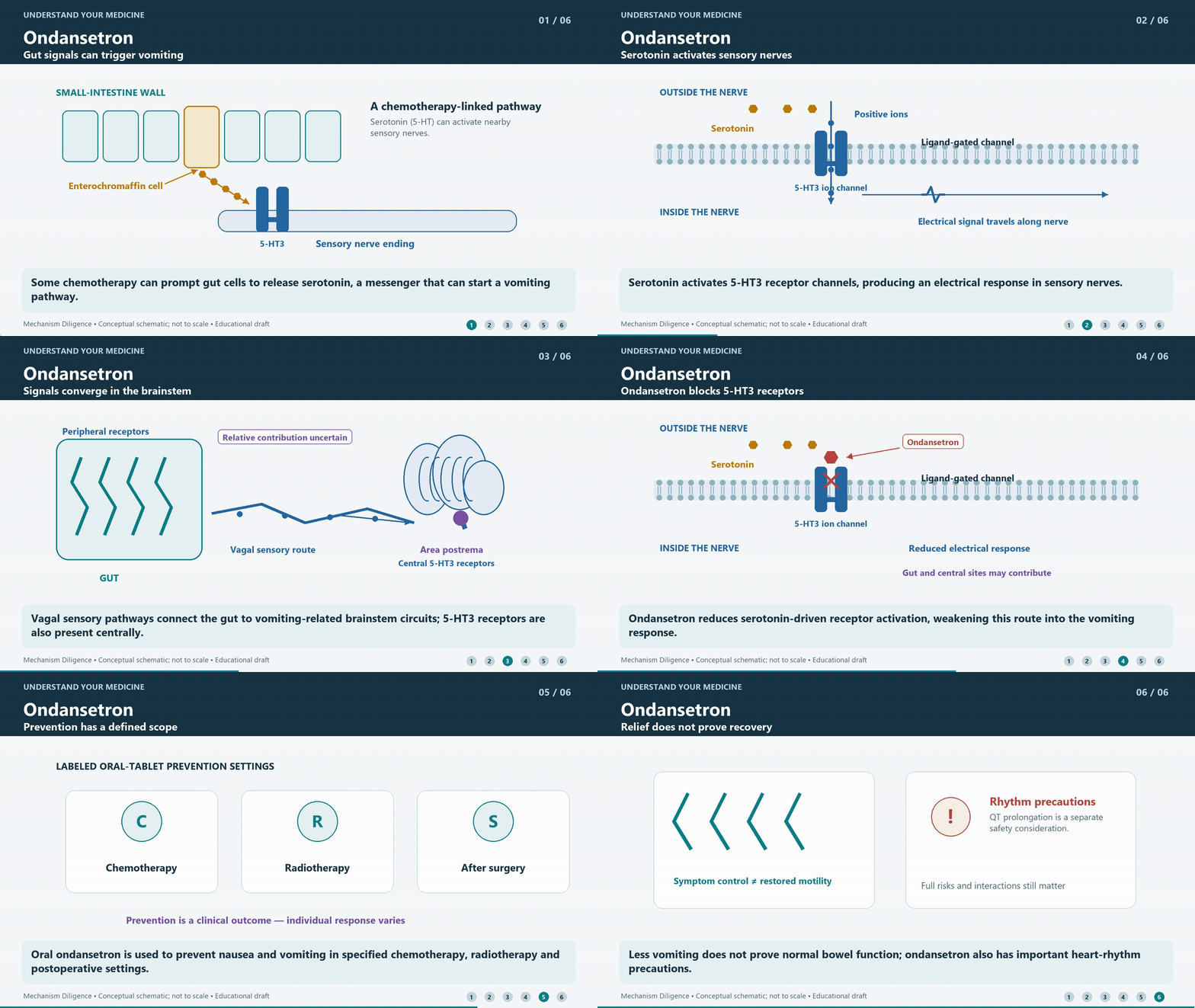
Some chemotherapy can prompt gut cells to release serotonin, a messenger that can start a vomiting pathway.
The label describes a proposed chemotherapy-linked sequence beginning with small-intestinal enterochromaffin cells. This example introduces physiology before showing receptor blockade.
The label uses cautious mechanistic language; this is one relevant pathway, not every cause of vomiting or a general model of chemotherapy action.
- Ondansetron hydrochloride tablets prescribing information, A-S Medication Solutions · Sections 1, 5.2, 5.5, 12.1-12.2, 14.1-14.3 · U.S. prescribing information; live selected sections checked · checked 2026-10-17
Chapter 2: Serotonin activates sensory nerves
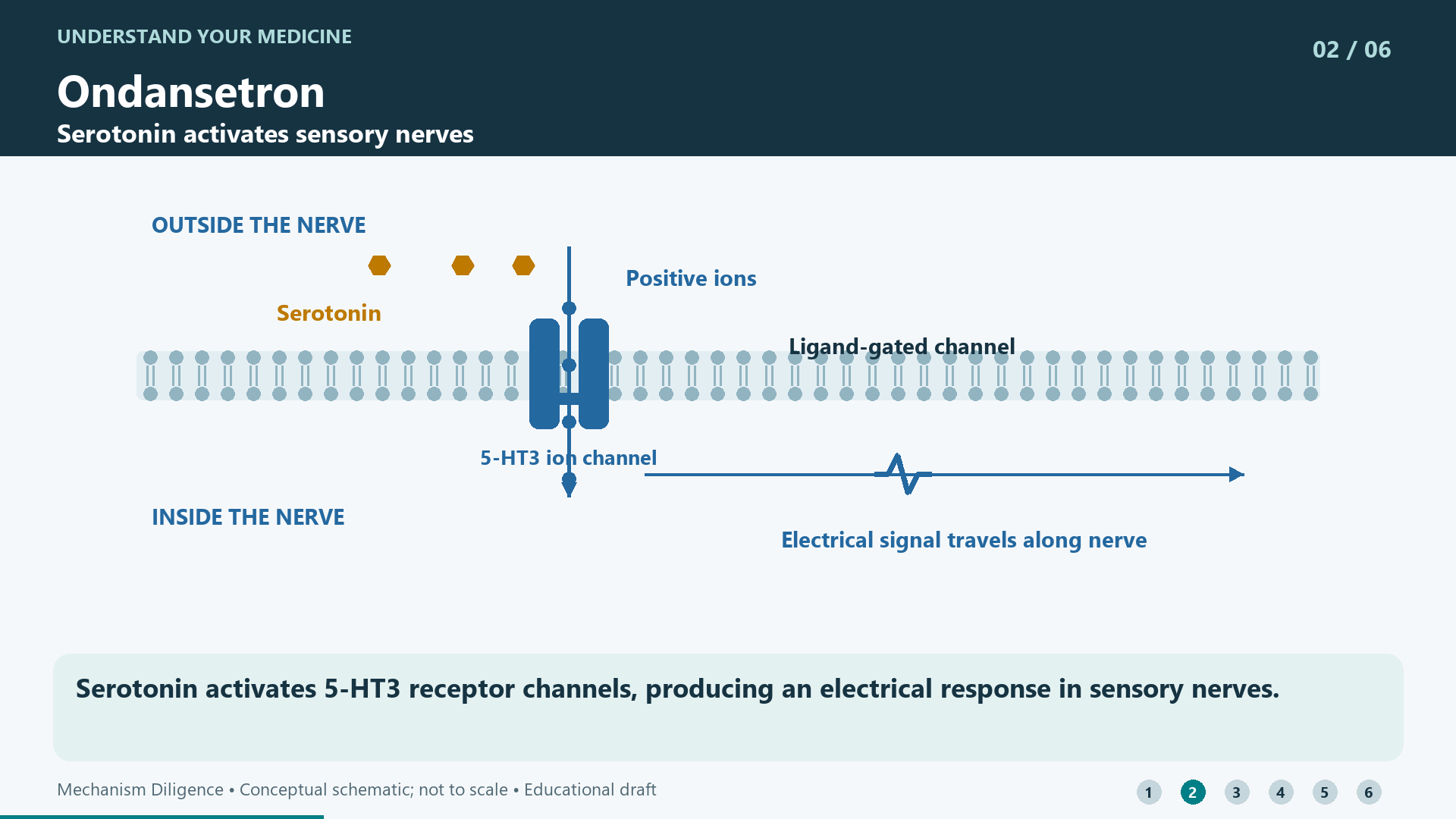
Serotonin activates 5-HT3 receptor channels, producing an electrical response in sensory nerves.
Patch-clamp experiments show serotonin-triggered cation currents through 5-HT3 receptors. These receptors are ligand-gated ion channels rather than the G-protein-coupled receptors found in many other serotonin pathways.
The current evidence is from experimental preparations. Channel shape, ion counts and pulse speed are not anatomical or quantitative measurements.
- Malone, Peters and Lambert. Physiological and pharmacological properties of 5-HT3 receptors: a patch-clamp study (1991) · Abstract: neuronal/cell-line cation currents and their antagonism by ondansetron; DOI 10.1016/0143-4179(91)90080-3 · Primary electrophysiology study in rabbit/guinea-pig neurons and a murine cell line; indexed abstract checked · checked 2026-10-17
- Jones and Surprenant. Single channel properties of the 5-HT3 subtype of serotonin receptor in primary cultures of rodent hippocampus (1994) · Abstract: serotonin-evoked currents and reversible antagonism; DOI 10.1016/0304-3940(94)90004-3 · Primary rodent neuronal electrophysiology; indexed abstract checked · checked 2026-10-17
Chapter 3: Signals converge in the brainstem
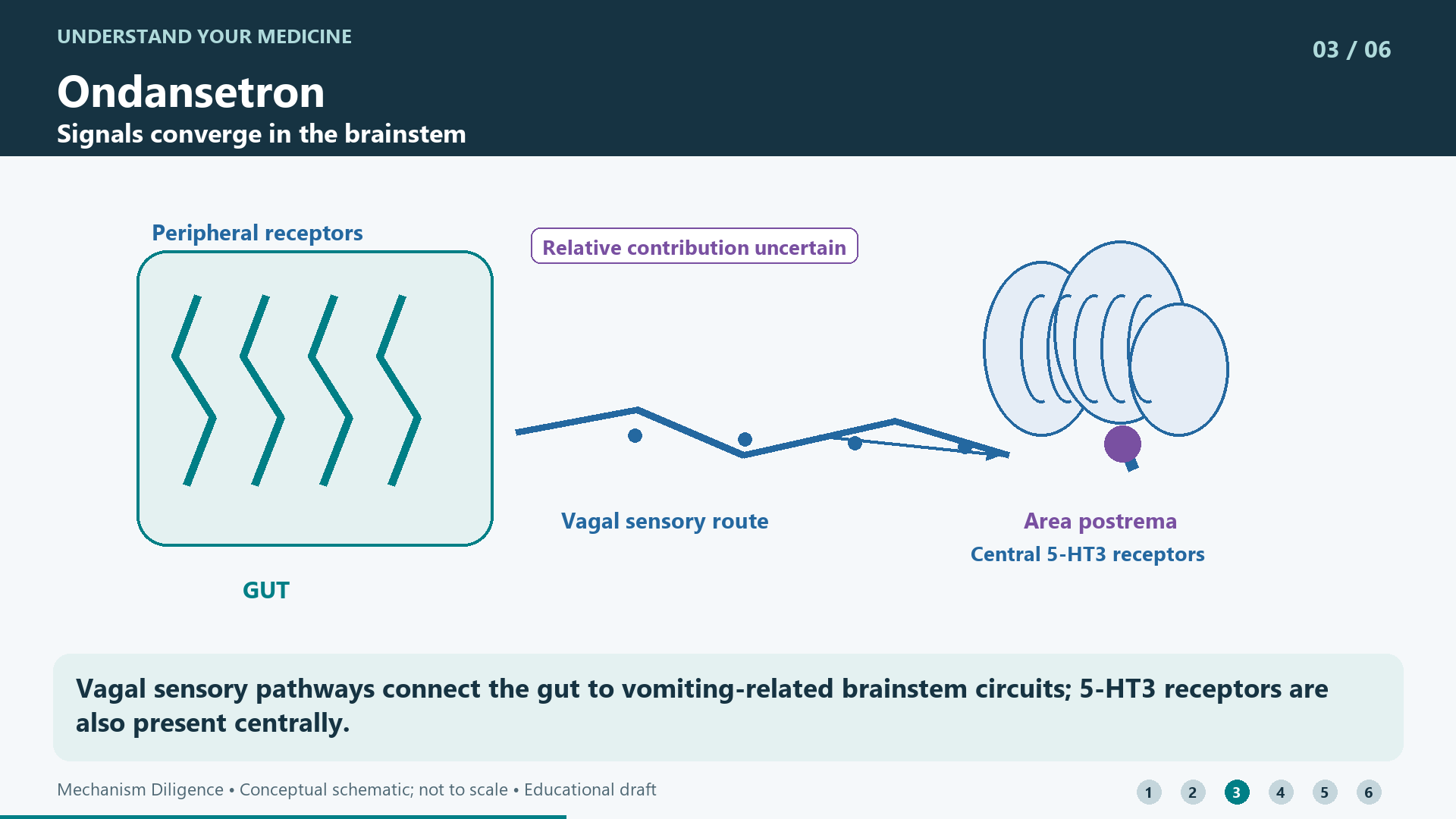
Vagal sensory pathways connect the gut to vomiting-related brainstem circuits; 5-HT3 receptors are also present centrally.
The label identifies peripheral vagal terminals and the area postrema as relevant receptor locations. Keep both locations visible and avoid choosing one as the proven dominant site of ondansetron's action.
The diagram omits most emetic circuitry; the central-versus-peripheral contribution is not settled by the cited label.
- Ondansetron hydrochloride tablets prescribing information, A-S Medication Solutions · Sections 1, 5.2, 5.5, 12.1-12.2, 14.1-14.3 · U.S. prescribing information; live selected sections checked · checked 2026-10-17
Chapter 4: Ondansetron blocks 5-HT3 receptors
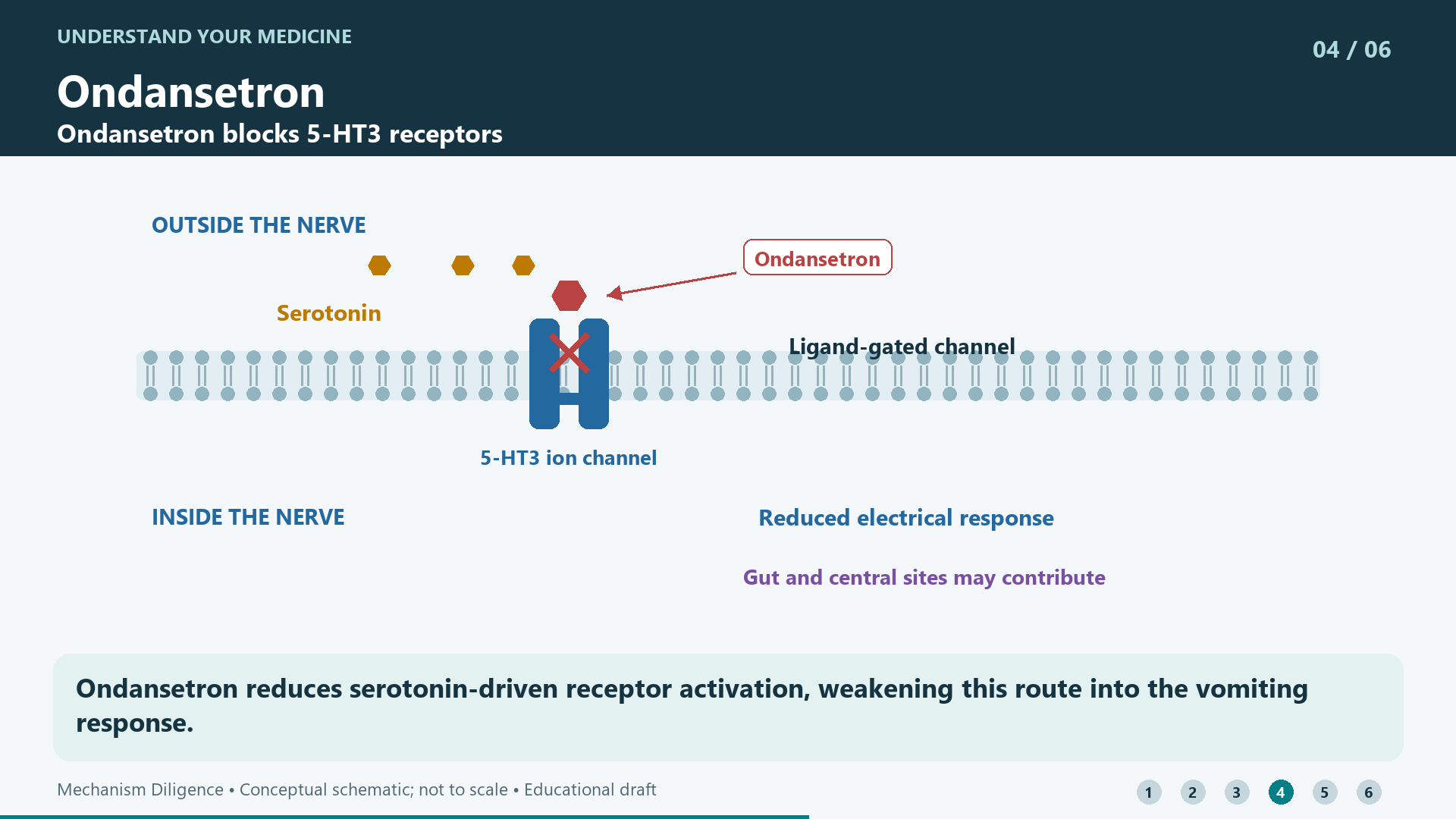
Ondansetron reduces serotonin-driven receptor activation, weakening this route into the vomiting response.
Experimental recordings show that ondansetron antagonizes serotonin-evoked currents. The mechanism is receptor antagonism; no serotonin-depletion or dopamine-receptor-blocking effect is needed to explain this scene.
Drug binding is an illustrative symbol, not a measured pose; blocking this route does not erase every emetic input.
- Malone, Peters and Lambert. Physiological and pharmacological properties of 5-HT3 receptors: a patch-clamp study (1991) · Abstract: neuronal/cell-line cation currents and their antagonism by ondansetron; DOI 10.1016/0143-4179(91)90080-3 · Primary electrophysiology study in rabbit/guinea-pig neurons and a murine cell line; indexed abstract checked · checked 2026-10-17
- Jones and Surprenant. Single channel properties of the 5-HT3 subtype of serotonin receptor in primary cultures of rodent hippocampus (1994) · Abstract: serotonin-evoked currents and reversible antagonism; DOI 10.1016/0304-3940(94)90004-3 · Primary rodent neuronal electrophysiology; indexed abstract checked · checked 2026-10-17
- Ondansetron hydrochloride tablets prescribing information, A-S Medication Solutions · Sections 1, 5.2, 5.5, 12.1-12.2, 14.1-14.3 · U.S. prescribing information; live selected sections checked · checked 2026-10-17
Chapter 5: Prevention has a defined scope
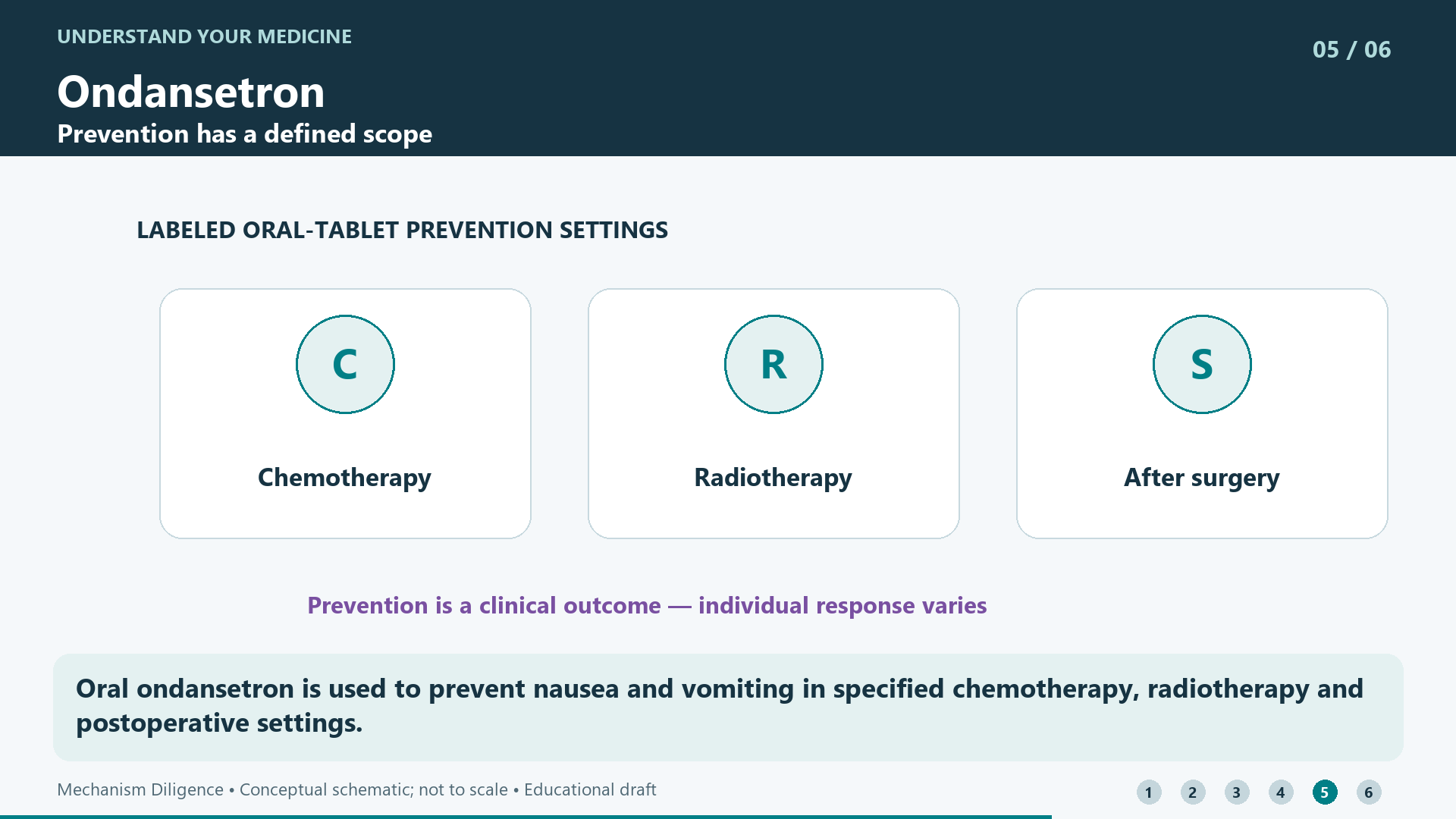
Oral ondansetron is used to prevent nausea and vomiting in specified chemotherapy, radiotherapy and postoperative settings.
Clinical-use scope comes from the tablet label and its trials, separately from the laboratory receptor evidence. Mechanistic plausibility is not an efficacy claim for unlisted causes of nausea.
The scene does not promise complete control, select a treatment regimen or extend the established scope to other formulations or indications.
- Ondansetron hydrochloride tablets prescribing information, A-S Medication Solutions · Sections 1, 5.2, 5.5, 12.1-12.2, 14.1-14.3 · U.S. prescribing information; live selected sections checked · checked 2026-10-17
Chapter 6: Relief does not prove recovery
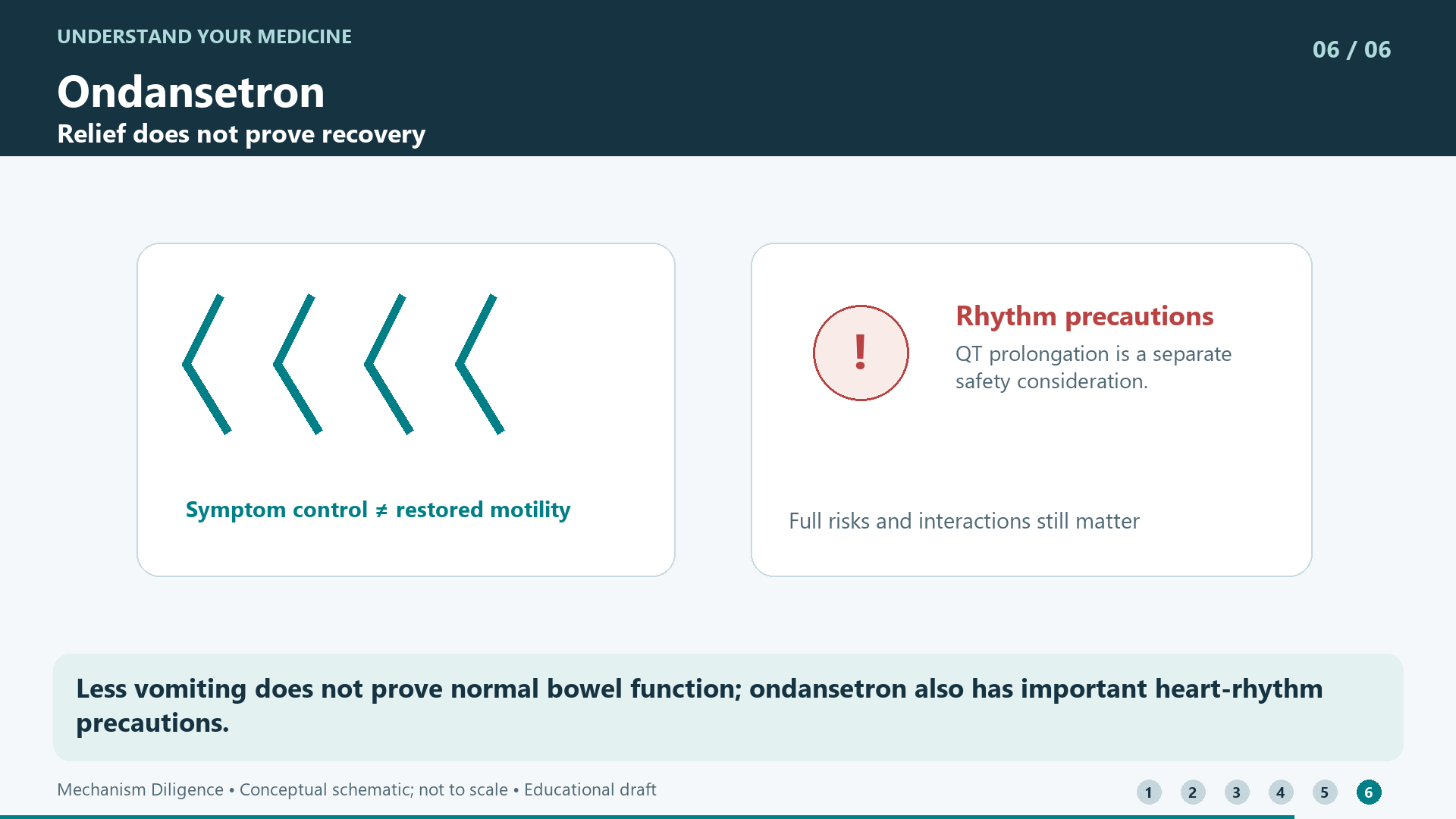
Less vomiting does not prove normal bowel function; ondansetron also has important heart-rhythm precautions.
The label warns about masking progressive ileus or distension and about QT prolongation. Reduced emetic signaling should not be shown as restored gut movement or absence of treatment risks.
Selected cautions are not a complete safety or interaction review; no individualized risk estimate is supplied.
- Ondansetron hydrochloride tablets prescribing information, A-S Medication Solutions · Sections 1, 5.2, 5.5, 12.1-12.2, 14.1-14.3 · U.S. prescribing information; live selected sections checked · checked 2026-10-17
Sources & scope
Source pages checked 2026-10-12. AI editorial source check; independent clinical review pending.
- Adult scope only; no dosing or regimen selection.
- Selective safety information; read the full prescribing information.
- Live HTML source check only; no retained XML or manufacturer-label reconciliation.
- Source mapping is not independent clinical review.
DailyMed / NLM ↗ · A-S Medication Solutions